An AI platform gives your business one governed place to connect data, build or select models, deploy them into products and processes and monitor how they perform, so AI moves from pilots into automation, analytics and customer-facing features that scale. The seven platforms below cover the three major cloud AI platforms, an enterprise platform built around governance, two open-source frameworks and an enterprise agent platform. Each entry shows what the platform does best, who it suits and how it charges in October 2026.
Why AI Platforms Matter for Automation, Analytics and Scale
An AI platform puts data, models, deployment and governance in one environment, which lets you run many AI use cases reliably instead of rebuilding infrastructure for each one. Single AI tools solve one task. A platform supports the whole lifecycle: preparing data, training or choosing models, deploying them through APIs or applications, and monitoring accuracy, cost and risk over time.
How do AI platforms differ from AI tools and applications?
AI tools deliver a finished feature to end users, while AI platforms give your technical teams the foundation to build and run many AI features. A writing assistant or chatbot is a tool. A platform supplies model access, compute, data pipelines, security controls and monitoring. Businesses usually adopt tools first, then move to a platform once several teams need AI built on company data. For ready-made options, compare free AI tools for business.
1. Microsoft Foundry (formerly Azure AI Foundry)
Microsoft Foundry suits large organisations on Azure and Microsoft 365 that want to build AI applications and agents inside their existing Microsoft environment.
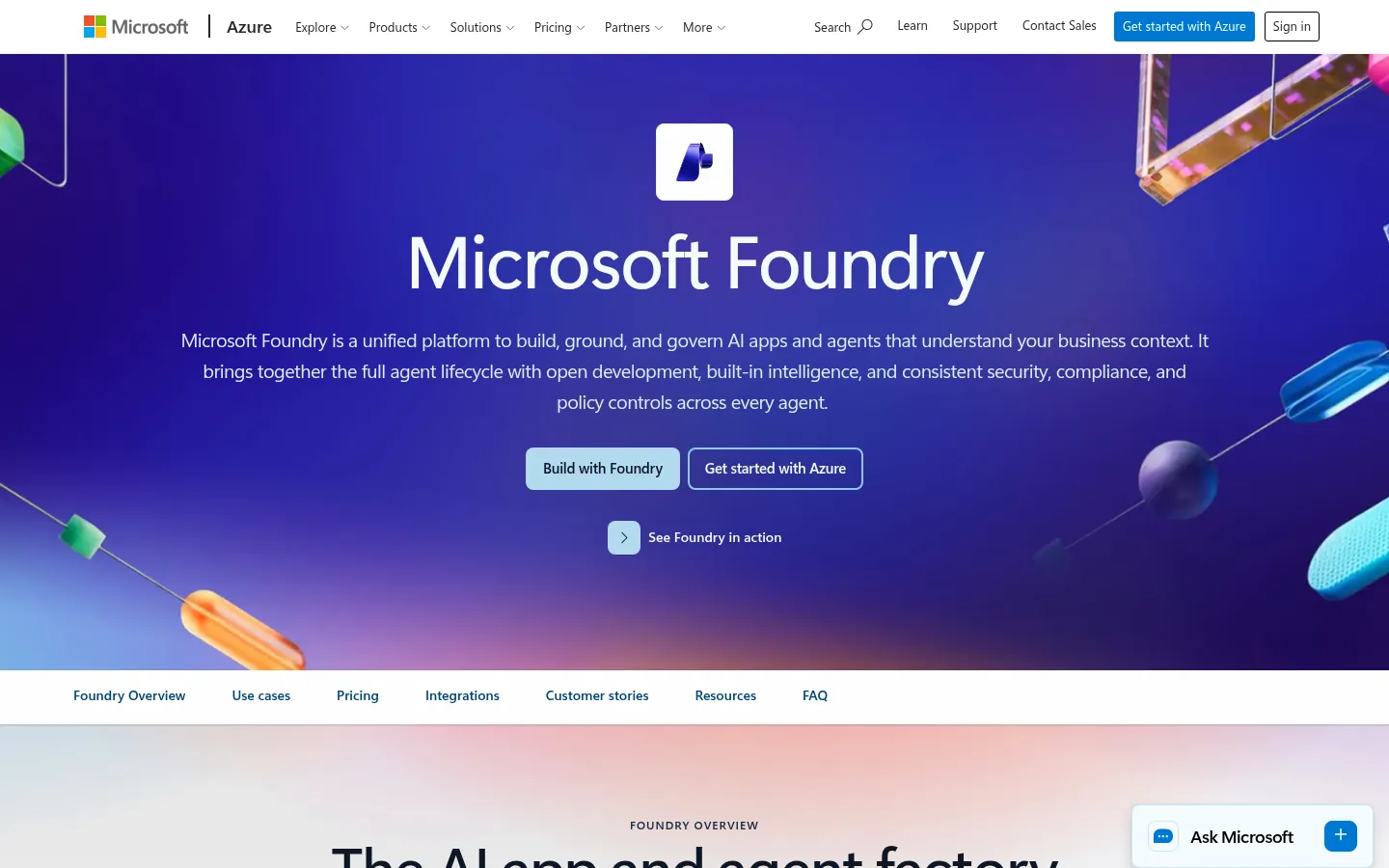
Screenshot: Microsoft Foundry website, October 2026.
Microsoft Foundry, formerly Azure AI Foundry, is Microsoft's platform for building AI applications and agents on Azure. It gives teams access to models, tools and Azure AI services, with Azure's identity, security and compliance controls.
Core features:
- Access to foundation models and Azure AI services
- Agent and application development tools
- Azure identity, security and compliance controls
- Integration with Microsoft 365 and Azure data services
How does Microsoft Foundry charge?
The Foundry platform is free to use and explore, and each model or service inside it carries its own usage-based price. A new Azure free account includes free services and a USD 200 credit for 30 days.
2. Gemini Enterprise Agent Platform (formerly Vertex AI)
Gemini Enterprise Agent Platform suits businesses on Google Cloud that want one platform for generative AI, agents, custom machine learning and data analytics.
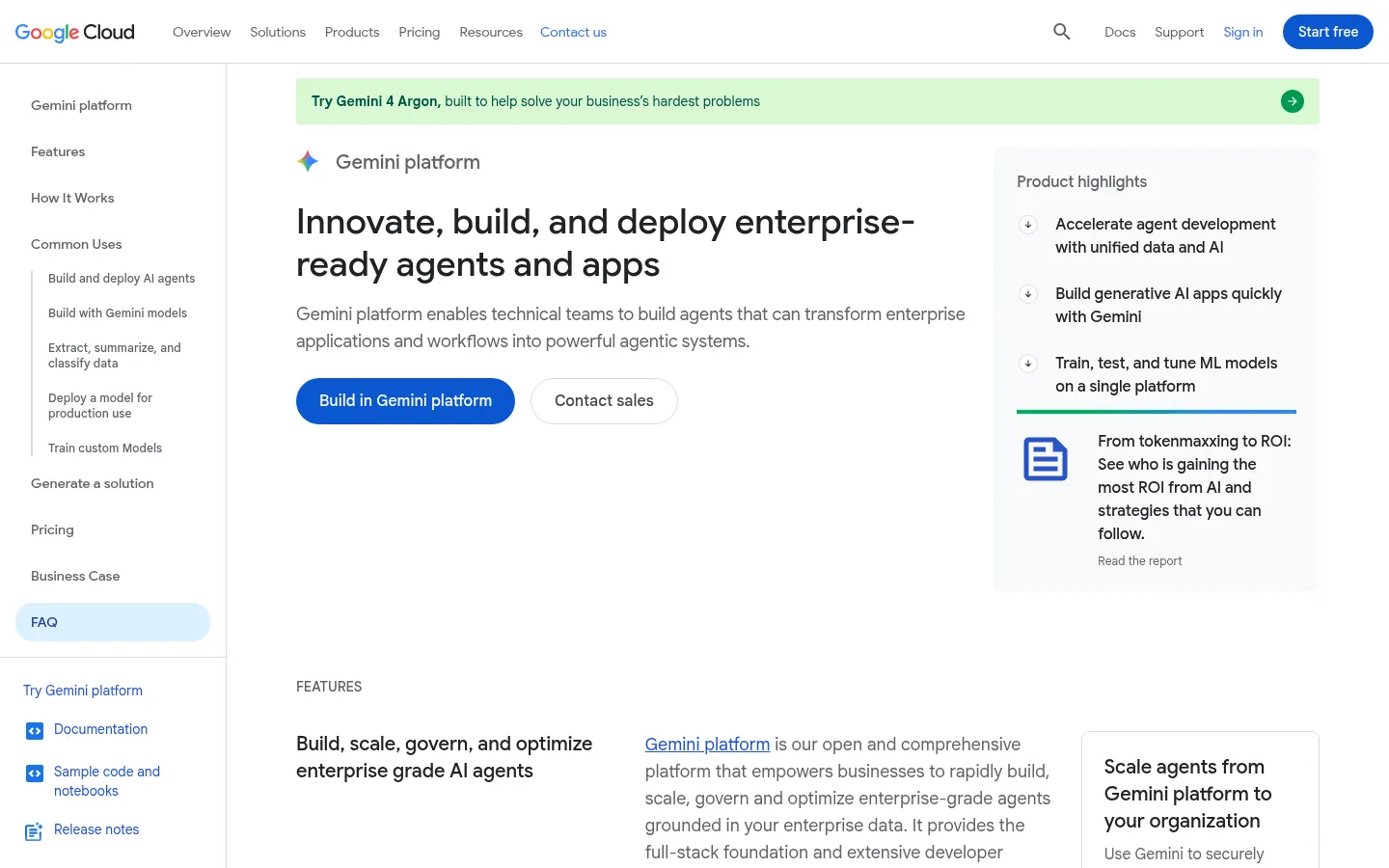
Screenshot: Gemini Enterprise Agent Platform website, October 2026.
Gemini Enterprise Agent Platform, formerly Vertex AI, is Google Cloud's platform for building, scaling and governing AI agents and machine learning, including Gemini models. Google's product page titles it the Gemini platform, and the old Vertex AI pages now redirect to it. It supports custom model training as well as managed models and agent tools.
Core features:
- Gemini and other foundation models
- Custom model training and deployment
- Agent building tools
- Integration with BigQuery and Google Cloud data services
How does Gemini Enterprise Agent Platform charge?
Gemini Enterprise Agent Platform charges by usage, such as model requests, tokens, training and prediction compute, so your cost depends on the models and workloads you run. Check the pricing page for each model before you estimate a monthly budget.
3. Amazon SageMaker AI
SageMaker AI suits businesses on AWS that run production machine learning workloads at scale.
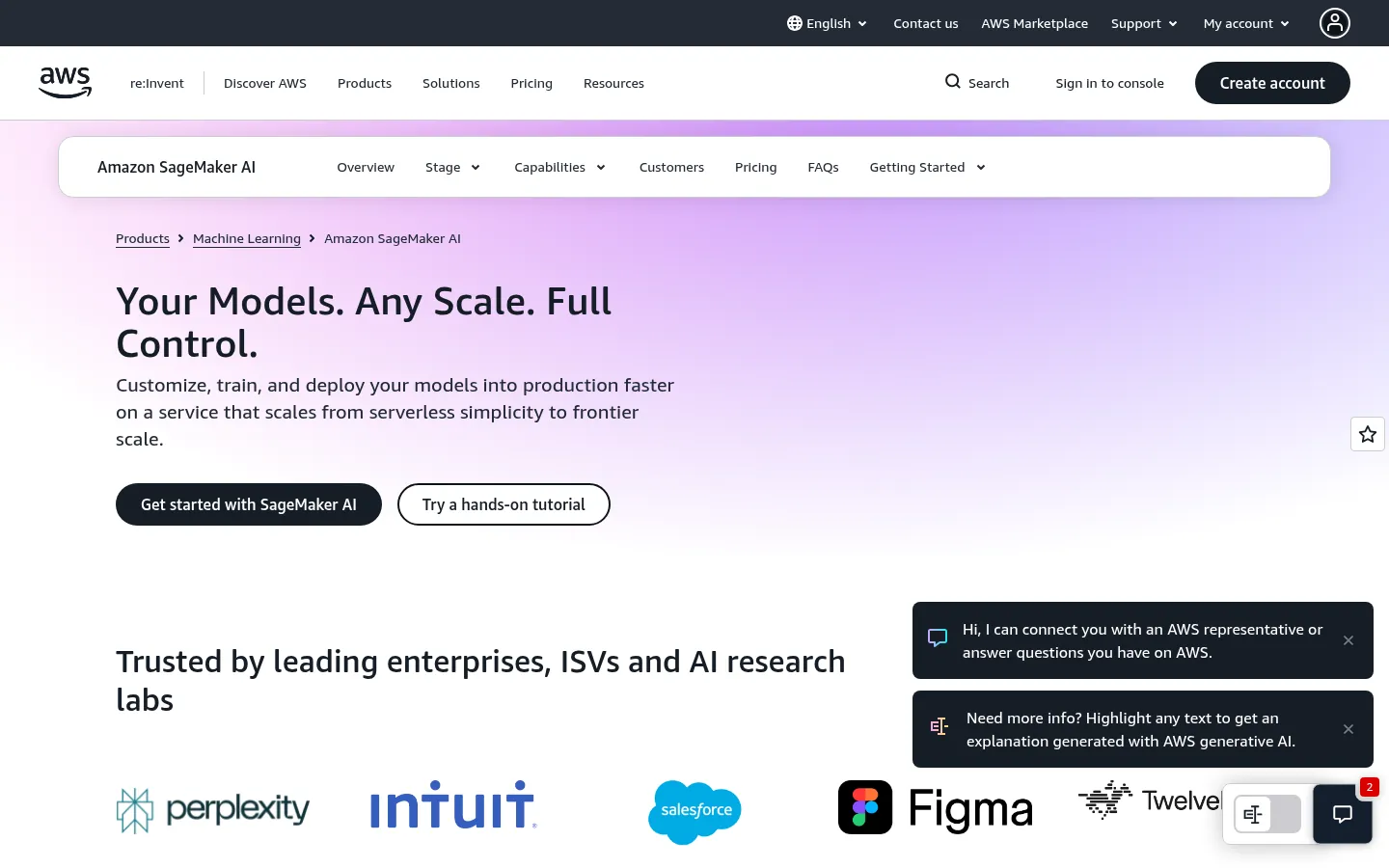
Screenshot: Amazon SageMaker AI website, October 2026.
Amazon SageMaker AI is AWS's managed service for building, training and deploying machine learning models. It covers notebooks, data preparation, training, real-time and serverless inference, and large-scale training clusters.
Core features:
- Studio notebooks and data preparation
- Managed training and HyperPod clusters
- Real-time and serverless inference
- Feature Store and model monitoring
How does SageMaker AI charge?
SageMaker AI charges only for what you use, on demand or through Savings Plans, and new users get a free tier for the first two months.
| Capability | Free tier allowance | Period | After the free tier | Suitable for |
|---|---|---|---|---|
| Studio notebooks | 250 hours of ml.t3.medium | Per month, first 2 months | On-demand instance hours | Exploration and prototyping |
| Training | 50 hours of m4.xlarge or m5.xlarge | Per month, first 2 months | On-demand instance hours | Model training |
| Real-time inference | 125 hours of m4.xlarge or m5.xlarge | Per month, first 2 months | On-demand instance hours | Live predictions |
| Serverless inference | 150,000 seconds | Per month, first 2 months | Per inference duration | Variable traffic |
| Canvas | 160 hours of session time | Per month, first 2 months | Per session hour | No-code machine learning |
Source: Amazon SageMaker AI pricing, checked October 2026.
4. IBM watsonx.ai
IBM watsonx.ai suits regulated enterprises that need AI with strong governance, explainability and control.
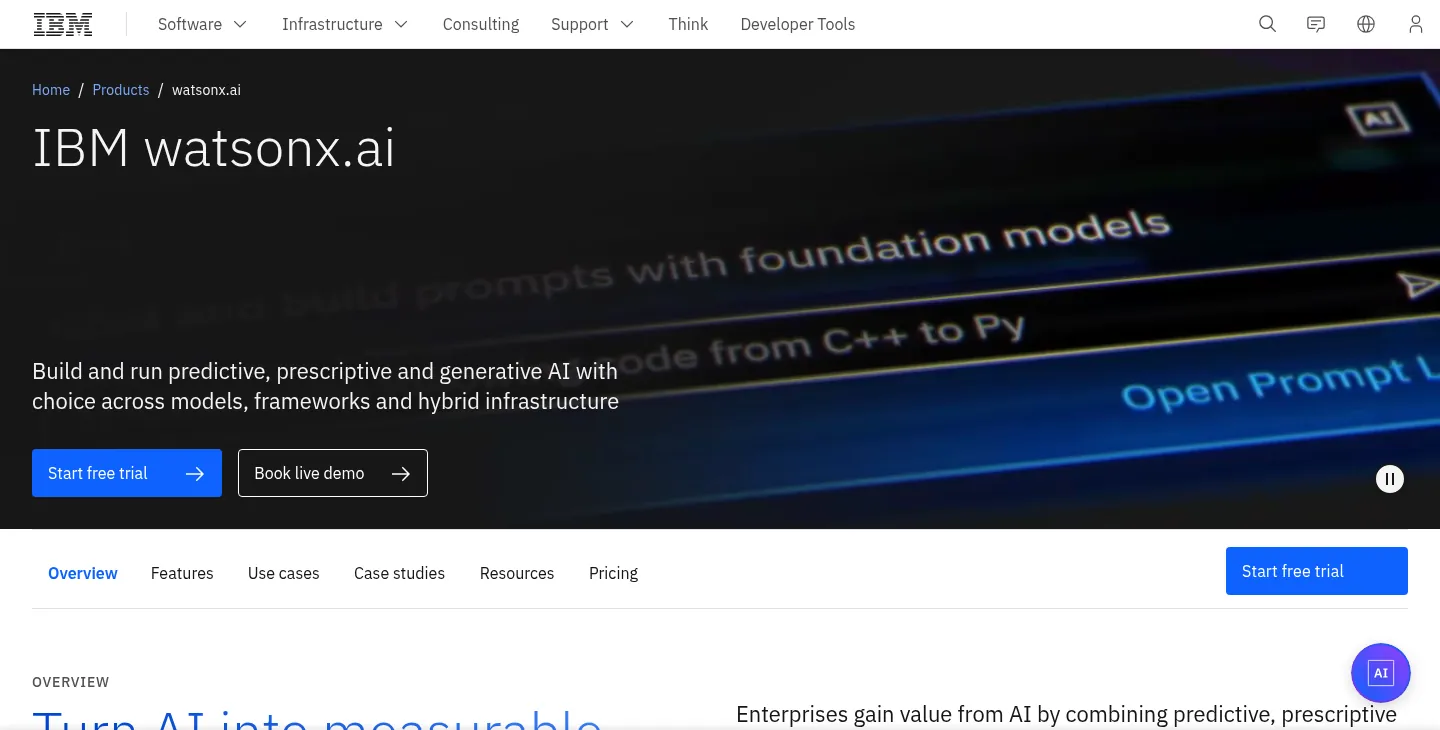
Screenshot: IBM watsonx.ai website, October 2026.
IBM watsonx.ai is IBM's studio for building with foundation models and machine learning. It sits within the watsonx portfolio, which adds data and governance products for organisations that need controlled AI adoption.
Core features:
- IBM and third-party foundation models
- Machine learning tools
- Text extraction from documents
- Governance through the wider watsonx portfolio
What does IBM watsonx.ai cost?
watsonx.ai has a free plan, a pay-as-you-go Essentials plan from USD 0 a month and a Standard plan from USD 1,110 a month.
| Plan | Price | Billing | Suitable for | Limits |
|---|---|---|---|---|
| Free | USD 0 | Monthly | Testing | 300,000 tokens, 20 compute hours, 100 documents a month |
| Essentials | From USD 0 a month | Pay as you go | Teams starting production use | Usage-based |
| Standard | From USD 1,110 a month | Pay as you go | Larger production workloads | Usage-based |
Source: IBM watsonx.ai pricing, checked October 2026.
5. TensorFlow
TensorFlow suits engineering teams that build and deploy deep learning models and want an open-source foundation.
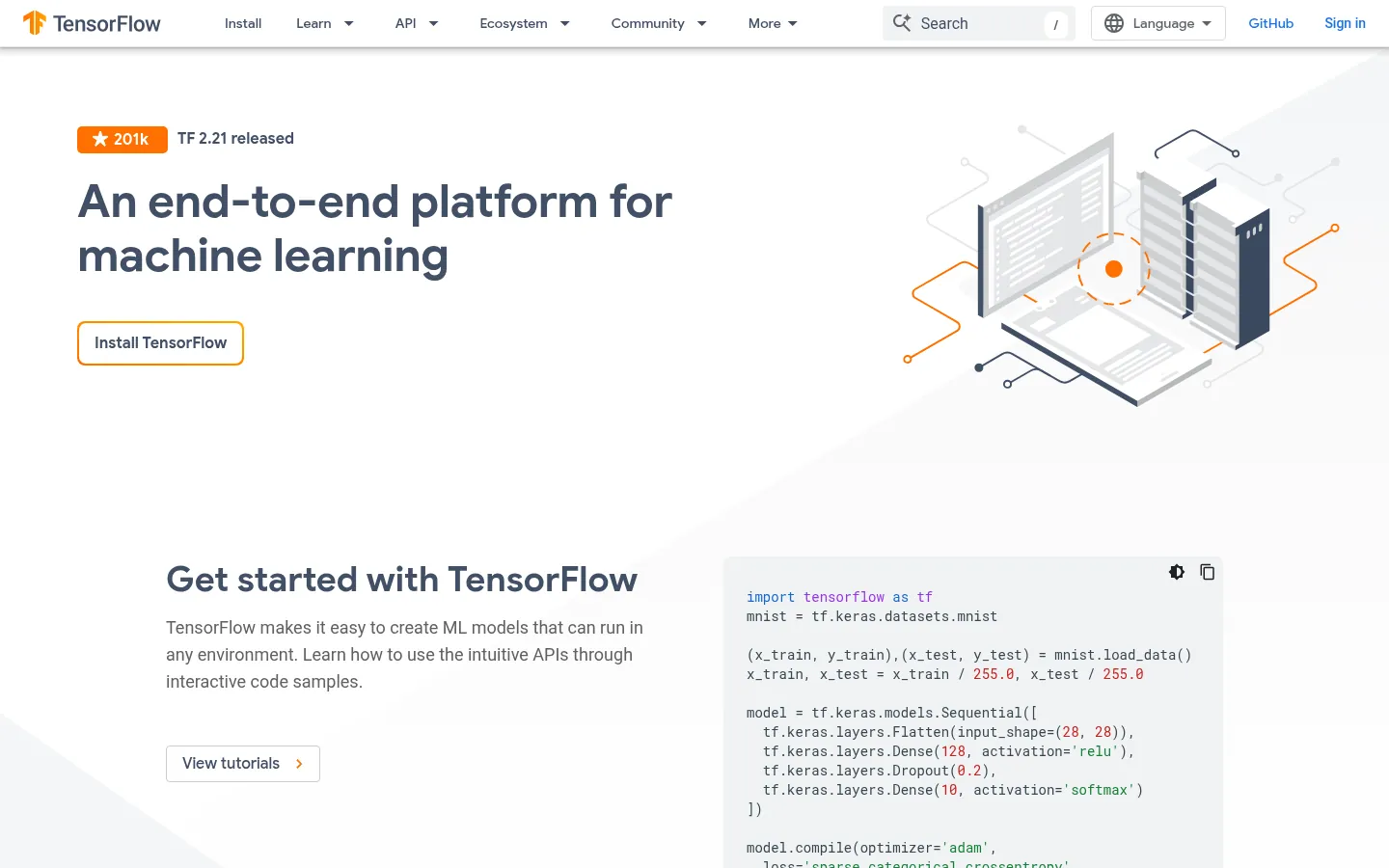
Screenshot: TensorFlow website, October 2026.
TensorFlow is an open-source machine learning framework created at Google. It provides the building blocks for training and serving models, and teams run it on their own hardware or on any cloud platform above.
Core features:
- Open-source deep learning framework
- Model training and serving
- Mobile and edge deployment options
- Large ecosystem of libraries
What does TensorFlow cost?
TensorFlow is free and open source; you pay only for the compute and infrastructure you run it on. It needs engineering skills to build and maintain models.
6. PyTorch
PyTorch suits research and engineering teams that value flexibility for experimentation and a smooth path to production.
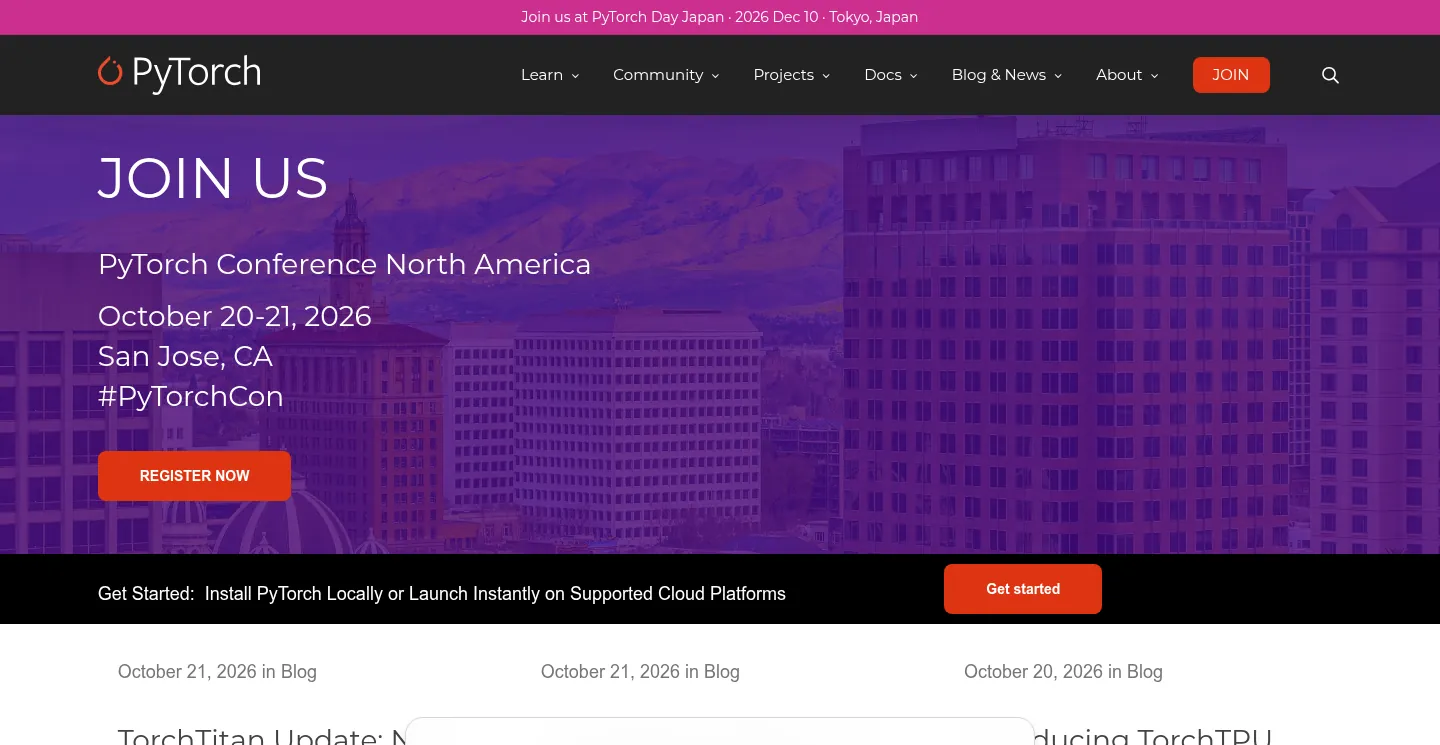
Screenshot: PyTorch website, October 2026.
PyTorch is an open-source deep learning framework governed by the PyTorch Foundation. It is widely used for research and production work, including large language models, and runs on local hardware or any major cloud.
Core features:
- Open-source deep learning framework
- Flexible model development
- Production deployment tools
- Support across major clouds and hardware
What does PyTorch cost?
PyTorch is free and open source; your cost comes from the cloud or on-premises infrastructure it runs on.
7. DataRobot
DataRobot suits enterprises that want to build, deploy and govern AI agents and predictive models with less manual data science work.
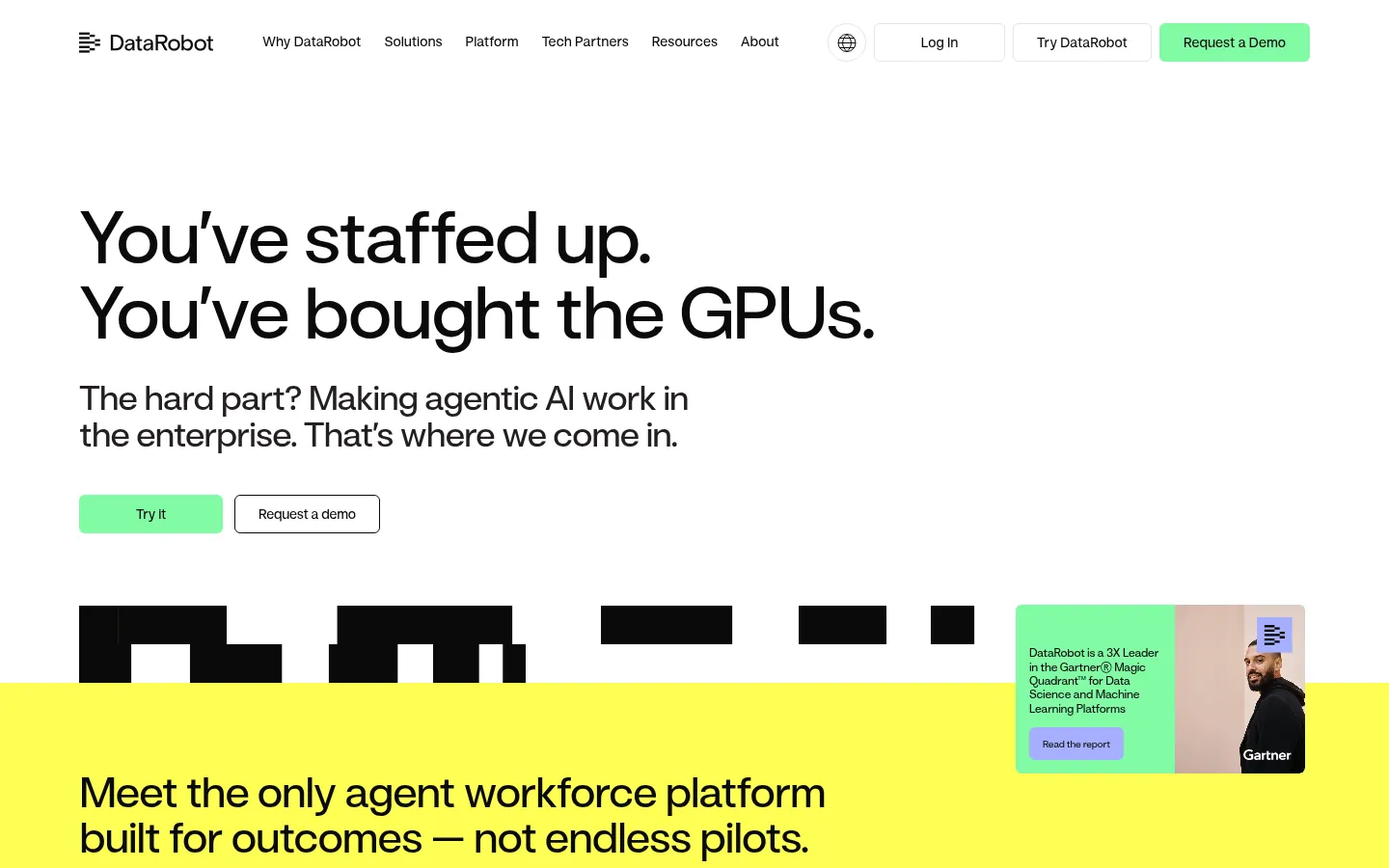
Screenshot: DataRobot website, October 2026.
DataRobot describes itself as a unified agent workforce platform for enterprise. It covers automated machine learning, agent development, deployment and governance, so teams move models and agents into production with oversight.
Core features:
- Automated machine learning
- AI agent development and deployment
- Model monitoring and governance
- Enterprise integrations
What does DataRobot cost?
DataRobot does not publish prices; its pricing link returns to the homepage, so you request a quote. It fits enterprises with budget for a managed platform and governance requirements.
How to Choose the Right AI Platform
Choose the platform that matches your existing cloud, data location and in-house skills, since moving data between clouds adds cost and risk. Weigh four factors: where your data already sits, the skills of your technical team, the governance and compliance your industry requires and how you prefer to pay.
Which AI platform fits which business?
Match the platform to your cloud, your team and your control needs.
| Platform | Role | Best for | Limitations | Pricing model |
|---|---|---|---|---|
| Microsoft Foundry (formerly Azure AI Foundry) | Cloud AI platform | Azure and Microsoft 365 organisations | Best inside Azure | Usage-based per service |
| Gemini Enterprise Agent Platform (formerly Vertex AI) | Cloud AI platform | Google Cloud and BigQuery users | Best inside Google Cloud | Usage-based |
| Amazon SageMaker AI | Cloud machine learning platform | AWS workloads at scale | Always-on instances add cost | On demand or Savings Plans |
| IBM watsonx.ai | Governed enterprise AI | Regulated industries | Higher entry for Standard | Free, pay as you go, Standard |
| TensorFlow | Open-source framework | Engineering-led teams | Needs infrastructure and skills | Free software |
| PyTorch | Open-source framework | Research and production teams | Needs infrastructure and skills | Free software |
| DataRobot | Enterprise agent and ML platform | Managed, governed AI | No public pricing | Quote |
Put Your AI Platform to Work
A platform pays off when it serves specific business outcomes, so pick two or three use cases with clear value before you scale. Each platform above fits a different cloud and skill set. Analyse results with AI data analysis tools, protect models and data with AI security tools, and track how AI assistants describe your brand with AI search tracking tools.