An ERP (enterprise resource planning) platform puts your finance, inventory, procurement, projects and people data into one system of record, so you report from one set of numbers and stop reconciling spreadsheets by hand. The seven platforms below cover small businesses moving off accounting software, mid-market firms running several entities and enterprises with global operations. Each entry gives you the pricing model and the kind of business it suits.
Why ERP Platforms Matter for Your Operations
An ERP platform gives your leadership team one view of cash flow, stock and resources, which protects margins as transaction volume and reporting demands grow. As a business grows, finance, inventory, procurement and project tracking tend to run in separate tools that do not share data. The result is duplicated records, conflicting reports and month-end work spent on manual consolidation. An ERP platform replaces those silos with one database and standard processes across departments.
For most growing organisations, adopting ERP is less about optimisation and more about keeping control as scale, transaction volume and regulatory requirements increase.
What does an ERP platform give your business?
An ERP platform gives you a single source of truth for financial and operational data, with standard workflows and reporting built on top of it. The main benefits:
- Centralises financial and operational data in one database.
- Standardises workflows across departments.
- Reports in real time for forecasting and planning.
- Reduces manual data entry and reconciliation.
- Improves auditability and compliance.
- Scales with new entities, users and transaction volume.
1. Oracle NetSuite
Oracle NetSuite suits mid-market companies that have outgrown basic accounting software and run several subsidiaries, regions or currencies.
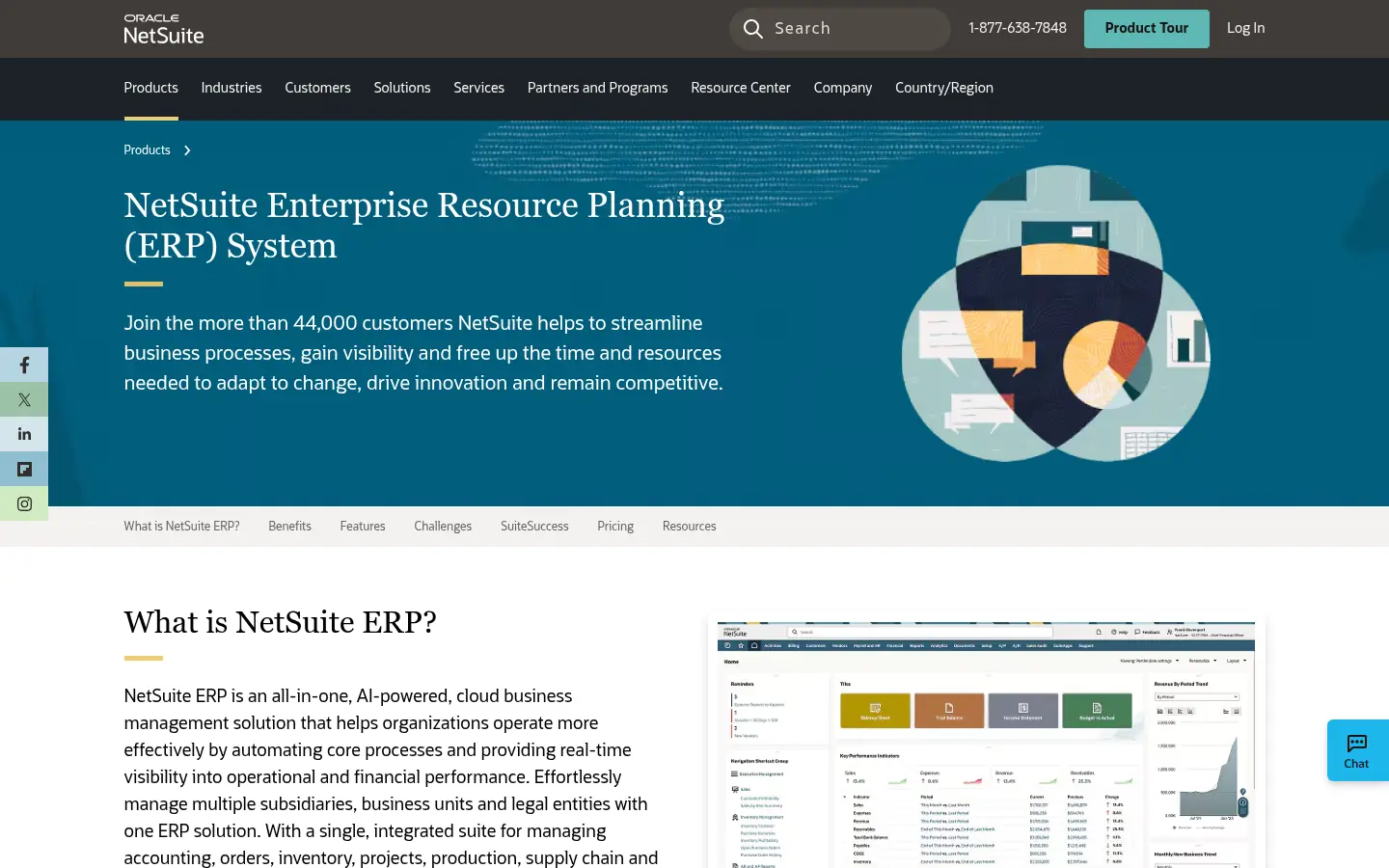
Screenshot: Oracle NetSuite website, October 2026.
Oracle NetSuite is a cloud ERP suite covering financials, inventory, order management and CRM. Its strength is broad, integrated functionality delivered entirely in the cloud, with consolidation across multiple entities and currencies. Most deployments run through an implementation partner.
Core features:
- Financial management and accounting
- Inventory and supply chain management
- Order and billing management
- CRM and customer data
- Multi-entity and multi-currency consolidation
How is Oracle NetSuite priced?
NetSuite does not publish a price; your licence combines a core platform fee, optional modules and the number of users. Total cost depends heavily on implementation scope, customisation and the number of entities, so it fits mid-market firms with budget and internal readiness for a structured rollout.
| Licence component | What it covers | Price | Suitable for | Watch-out |
|---|---|---|---|---|
| Core platform | Base ERP licence | Quote-based | Growing mid-market firms | Implementation cost on top |
| Optional modules | Added functions such as advanced inventory | Quote-based | Multi-entity operations | Cost rises with each module |
| Users | Per-user access | Quote-based | Teams of any size | Partner dependency |
Source: NetSuite ERP, checked October 2026.
2. Microsoft Dynamics 365
Microsoft Dynamics 365 suits businesses already working in Microsoft 365 that want to add ERP functions one module at a time.
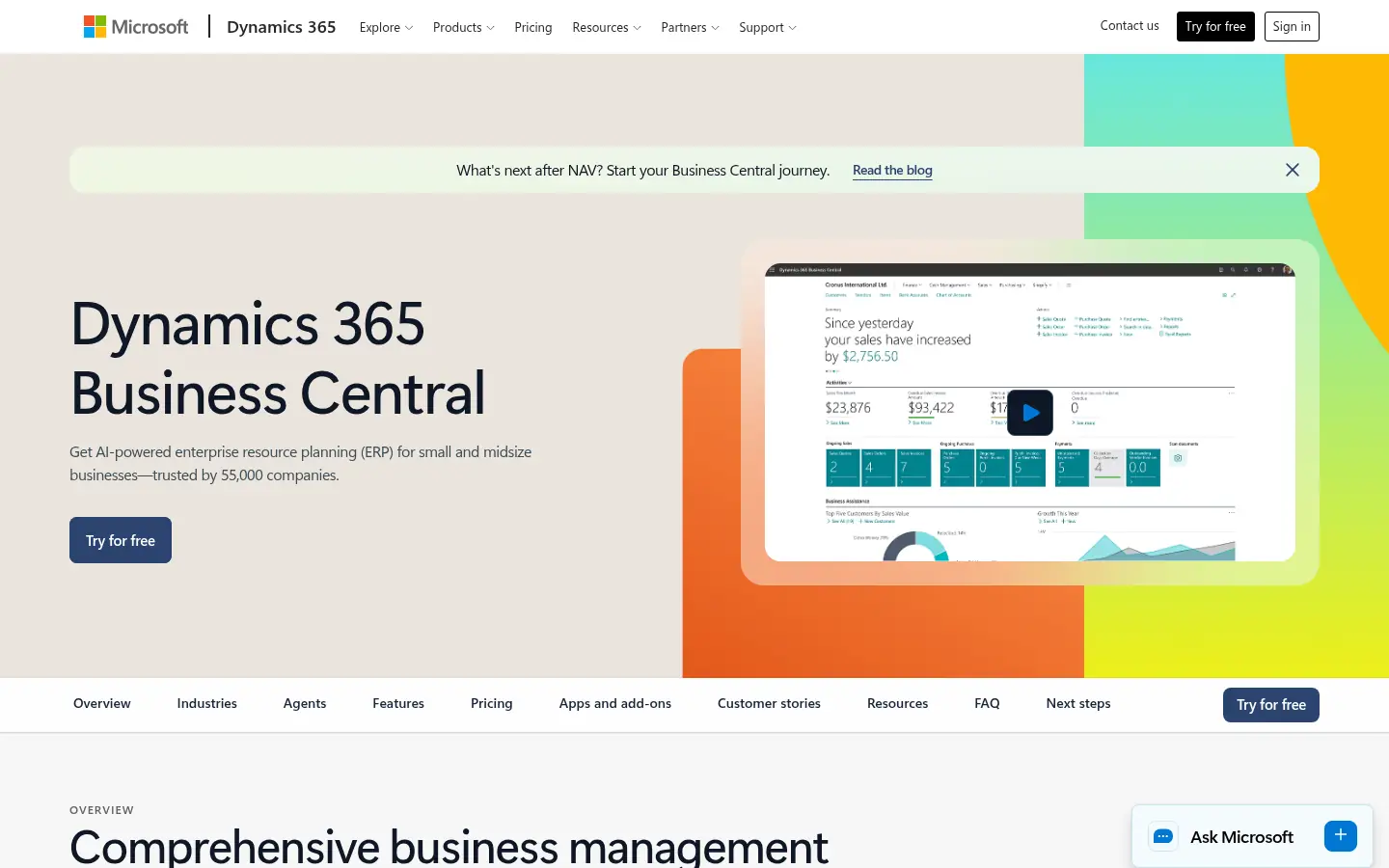
Screenshot: Microsoft Dynamics 365 website, October 2026.
Microsoft Dynamics 365 delivers ERP through Business Central for small and mid-sized businesses and through Finance and Supply Chain Management for larger organisations. You license only the modules you need, though licensing gets more complex as usage expands.
Core features:
- Financial management and reporting
- Inventory and supply chain management
- Sales and customer operations
- Integration with Microsoft 365 and Power Platform
- Modular deployment by function
How is Microsoft Dynamics 365 Business Central priced?
Business Central is priced per user per month on a yearly commitment, while Finance and Supply Chain Management are quoted for larger organisations.
| Plan | Price | Billing | Suitable for | Limits |
|---|---|---|---|---|
| Business Central Essentials | USD 80 per user per month | Paid yearly | Small and mid-sized businesses | Fewer advanced manufacturing features |
| Business Central Premium | USD 110 per user per month | Paid yearly | Businesses needing manufacturing and service management | Higher per-user cost |
| Business Central Team Members | USD 8 per user per month | Paid yearly | Staff who view data and approve tasks | Limited editing rights |
| Finance and Supply Chain Management | Quote-based | Enterprise agreement | Mid-market and enterprise | Licensing complexity |
Source: Business Central pricing, checked October 2026.
3. SAP S/4HANA
SAP S/4HANA suits large enterprises with complex manufacturing, supply chain and regulatory reporting requirements.
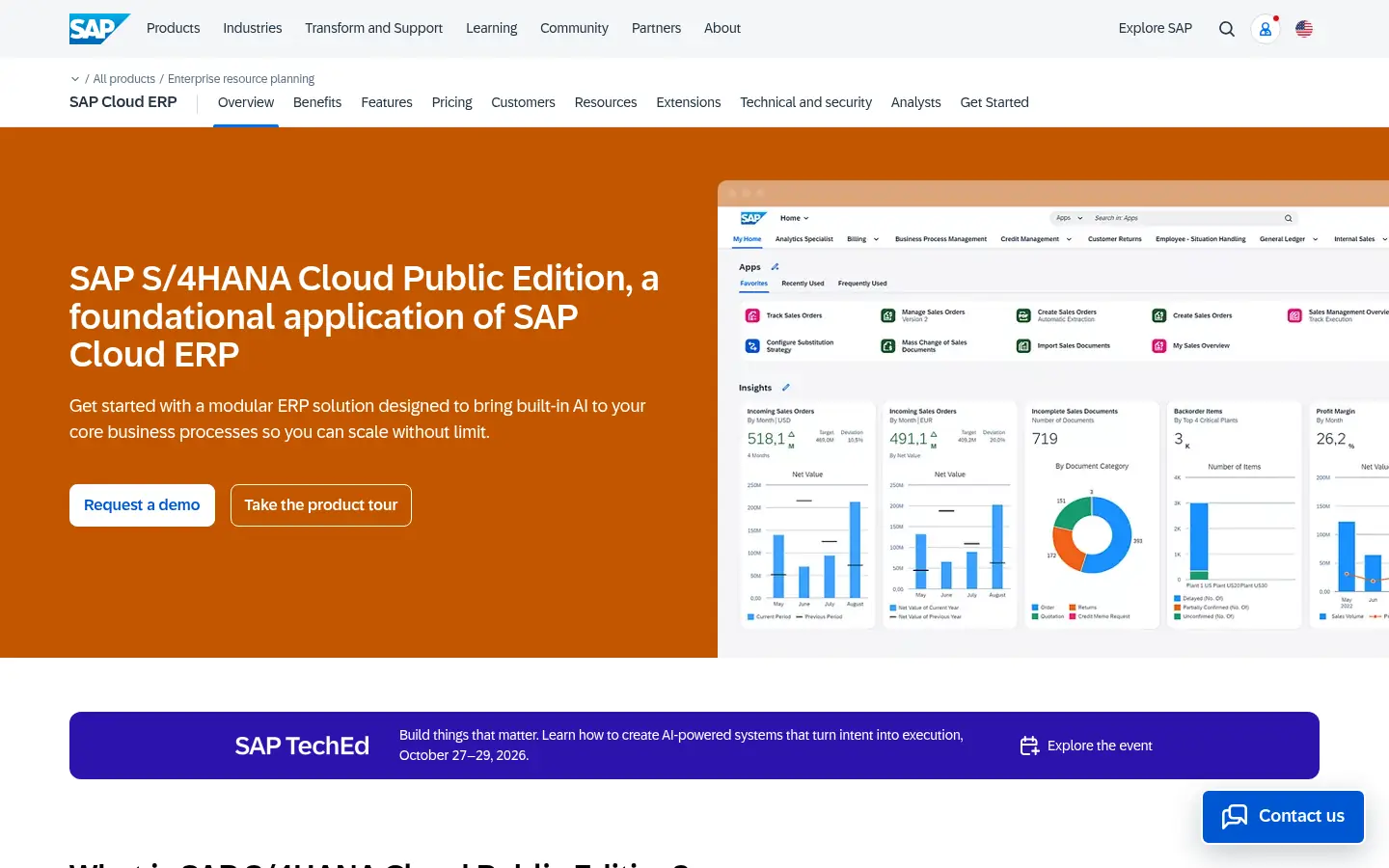
Screenshot: SAP S/4HANA website, October 2026.
SAP S/4HANA is SAP's flagship ERP for end-to-end processes across finance, manufacturing, supply chain and logistics. It is built for deep process control and is usually deployed with experienced SAP implementation partners and a formal change programme.
Core features:
- Advanced financial management
- Manufacturing and production planning
- Global supply chain management
- Compliance and regulatory reporting
- Enterprise-scale data processing
How is SAP S/4HANA priced?
SAP S/4HANA has no standard public price; your cost depends on deployment model, industry requirements and organisational complexity. Budgets cover software licences, infrastructure, implementation services and long-term support, so it fits large enterprises prepared for significant upfront investment.
| Cost element | What it covers | Price | Suitable for | Watch-out |
|---|---|---|---|---|
| Software licence | S/4HANA cloud or on-premise subscription | Quote-based | Large enterprises | High total cost |
| Implementation | Partner-led design and rollout | Quote-based | Multinational firms | Long implementation |
| Support | Ongoing maintenance and upgrades | Quote-based | Regulated industries | Operational complexity |
Source: SAP S/4HANA, checked October 2026.
4. SAP Business One
SAP Business One suits product-based small and mid-sized businesses that need inventory, finance and basic operations on one platform.
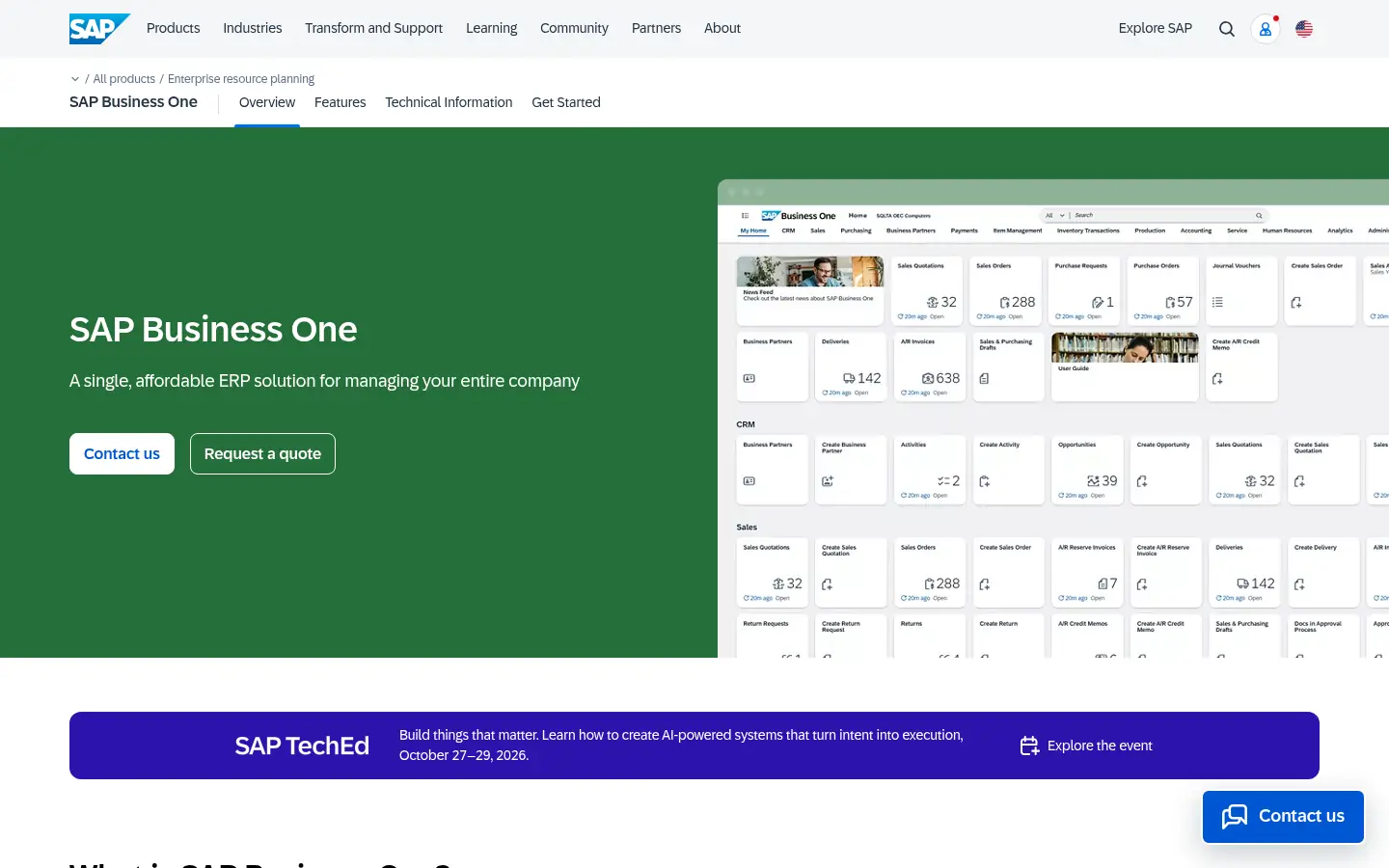
Screenshot: SAP Business One website, October 2026.
SAP Business One is SAP's ERP for small and medium-sized businesses. It gives you core ERP functions without the depth and complexity of S/4HANA, which makes it a common next step after accounting software.
Core features:
- Financial accounting and reporting
- Inventory and warehouse management
- Sales and purchasing workflows
- Basic production management
- Standardised ERP processes
How is SAP Business One priced?
SAP Business One is sold per user through SAP partners, so your price depends on the partner, the deployment method and the user types you choose. Pricing is more predictable than for SAP's enterprise platforms, but it is not published as a standard list price.
| Option | What it covers | Price | Suitable for | Watch-out |
|---|---|---|---|---|
| Professional user | Full access to all modules | Partner quote | SMEs | Limited scalability for complex groups |
| Limited user | Access to selected functions | Partner quote | Growing SMBs | Fewer modules per user |
| Industry add-ons | Vertical extensions | Partner quote | Specific industries | Partner reliance |
Source: SAP Business One, checked October 2026.
5. Odoo
Odoo suits small businesses that want a modular, flexible ERP and have the time or a partner to configure it.
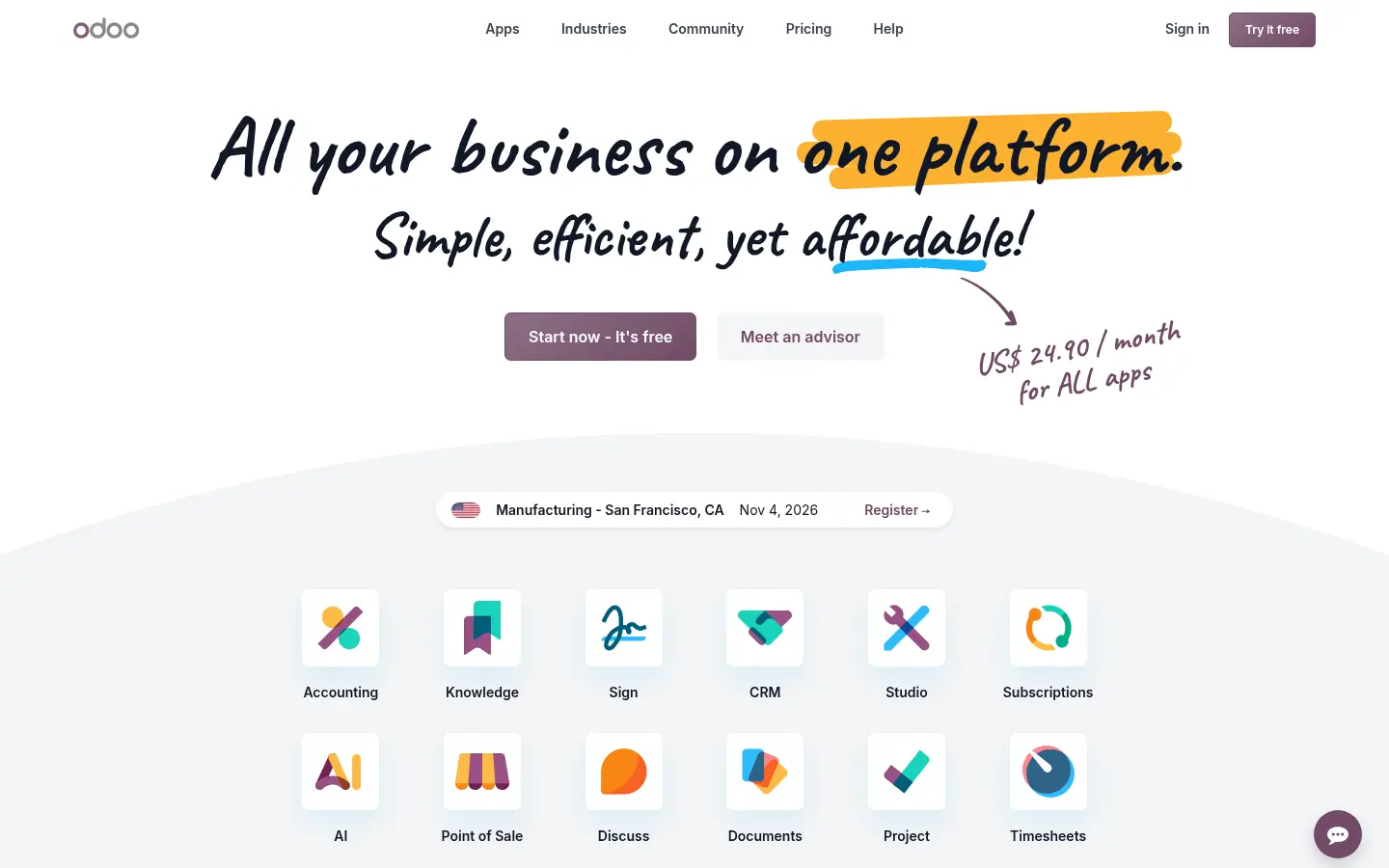
Screenshot: Odoo website, October 2026.
Odoo is an open-source, modular ERP where you switch on only the apps you need, from accounting and inventory to manufacturing, CRM and sales. It runs in Odoo's cloud, on Odoo.sh or on your own servers. Results depend heavily on configuration quality.
Core features:
- Modular ERP applications
- Financial and accounting tools
- Inventory and manufacturing
- CRM and sales management
- Customisable workflows
How is Odoo priced?
Odoo prices per user per month, with one app free and all apps on the Standard and Custom plans. The pricing page shows lower rates for annual billing and higher rates for monthly billing, and prices vary by country.
| Plan | Price | Billing | Suitable for | Limits |
|---|---|---|---|---|
| One App Free | USD 0 | Free | Testing one app | One app only, Odoo Online |
| Standard | From USD 24.30 per user per month | Billed annually; higher monthly rate | SMEs | Odoo Online only |
| Custom | From USD 49.60 per user per month | Billed annually; higher monthly rate | Complex workflows | Needs technical set-up |
Source: Odoo pricing, checked October 2026.
6. Acumatica
Acumatica suits mid-market distribution, manufacturing and construction businesses with many users who need system access.
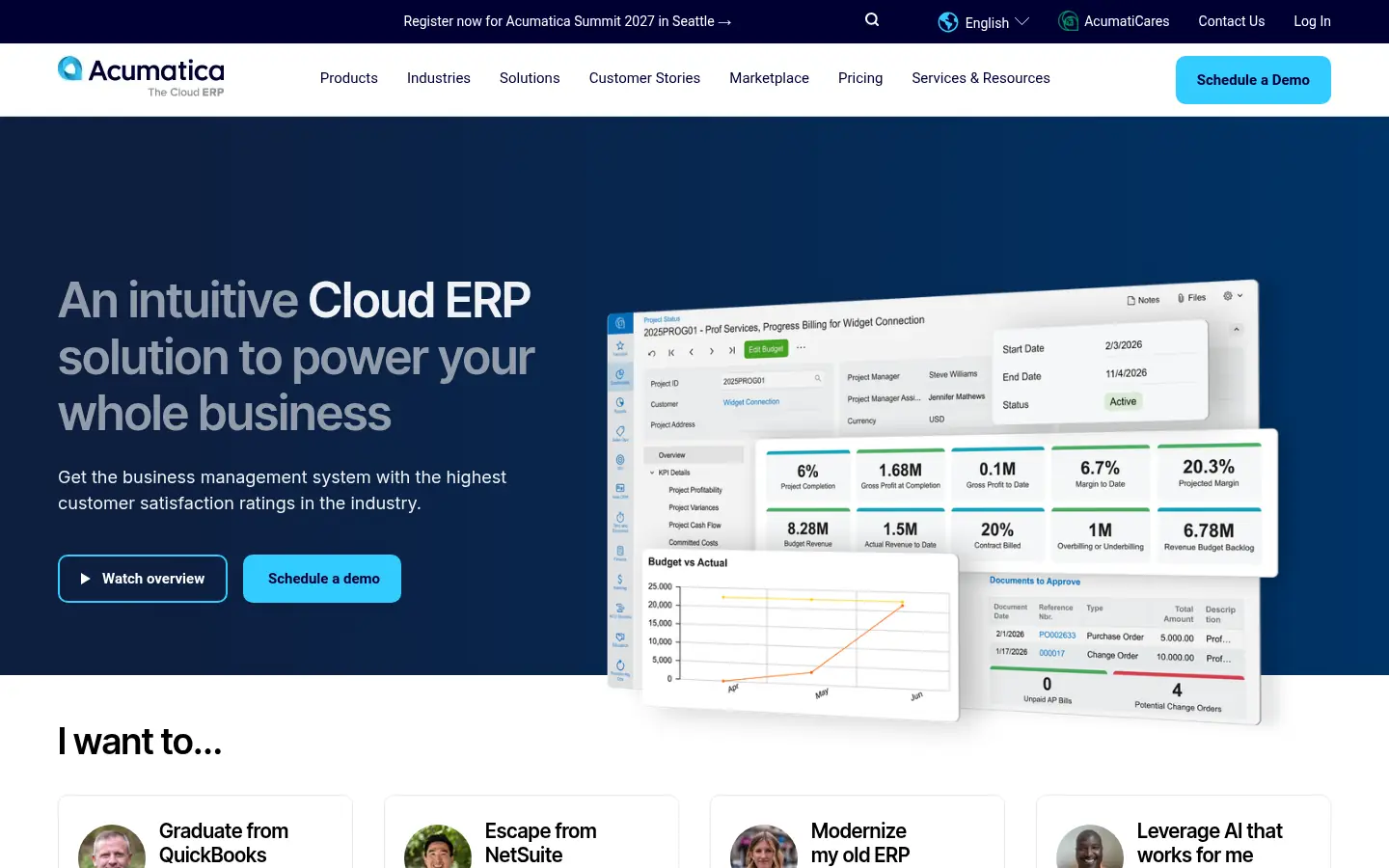
Screenshot: Acumatica website, October 2026.
Acumatica is a cloud ERP that charges by the system resources you use rather than per user licence, so adding users does not add licence cost. It offers industry editions for distribution, manufacturing and construction.
Core features:
- Financial management
- Distribution and manufacturing modules
- Project accounting
- Resource-based pricing
- Cloud-native architecture
How is Acumatica priced?
Acumatica is quoted through partners, with price set by edition, modules and transaction volume rather than by user count. That model fits mid-market businesses with many users who want predictable licensing and are comfortable with partner-led deployment.
| Edition | What it covers | Price | Suitable for | Watch-out |
|---|---|---|---|---|
| General Business | Core financials and operations | Partner quote | Growing businesses | Partner-led set-up |
| Industry editions | Distribution, manufacturing, construction | Partner quote | Vertical-specific needs | Edition choice affects cost |
| Enterprise scale | Higher resource levels | Partner quote | Complex operations | Implementation effort |
Source: Acumatica, checked October 2026.
7. Workday
Workday suits large, service-based organisations that put financial planning and workforce management ahead of inventory or manufacturing.

Screenshot: Workday website, October 2026.
Workday covers financial management and human capital management for large employers and institutions. It is not built for inventory-heavy or manufacturing-led businesses, but it is strong in people-driven operating models.
Core features:
- Financial management and planning
- Human capital management
- Workforce analytics
- Payroll and compliance
- Enterprise reporting
How is Workday priced?
Workday pricing is fully custom, based on your organisation's size, chosen modules and workforce complexity, with no small-business tier. Implementation costs are high, so it fits large organisations.
| Product | What it covers | Price | Suitable for | Watch-out |
|---|---|---|---|---|
| Financial Management | Accounting, planning, reporting | Quote-based | Service-based firms | Not inventory-centric |
| Human Capital Management | HR, talent, payroll | Quote-based | Large employers | High cost |
| Combined suite | Finance and HCM together | Quote-based | Complex organisations | Narrow operational scope |
Source: Workday, checked October 2026.
How to Choose the Right ERP Platform
Choose the ERP that matches how your business runs today and how it will grow, because a mismatch between system and complexity leads to costly re-implementation. Weigh company size, industry requirements, transaction volume and your team's capacity to manage change. Then check integration needs, reporting and regulatory obligations and the total cost of ownership, including implementation and support.
Which ERP platform fits which business?
Match the platform to your size and operating model: SMEs, mid-market groups, global enterprises or service-led organisations.
| ERP platform | Best for | Strengths | Limitations | Pricing model |
|---|---|---|---|---|
| Oracle NetSuite | Mid-market | Cloud-native, multi-entity | Cost and partner reliance | Quote: platform, modules, users |
| Dynamics 365 | SMEs to mid-market | Flexibility, Microsoft ecosystem | Licensing complexity | Per user per month |
| SAP S/4HANA | Enterprises | Depth, compliance | Cost and complexity | Quote-based |
| SAP Business One | SMBs | Integrated core ERP | Limited scalability | Per user, partner quote |
| Odoo | SMEs | Flexibility, cost control | Configuration effort | Per user per month |
| Acumatica | Mid-market | Resource-based pricing | Partner dependency | By resources and edition |
| Workday | Service-based firms | Finance and HCM depth | Not product-centric | Quote-based |
Turn ERP Data Into Decisions
An ERP platform gives you clean operational data, and the return comes from the reports and decisions you build on top of it. Each platform above serves a different type of organisation, so pick on operational complexity, industry needs and growth plans. Many businesses pair ERP with data analytics tools to visualise trends and monitor KPIs, and with human resource tools where people operations sit outside the ERP. Browse more roundups on the SaaS tools hub.