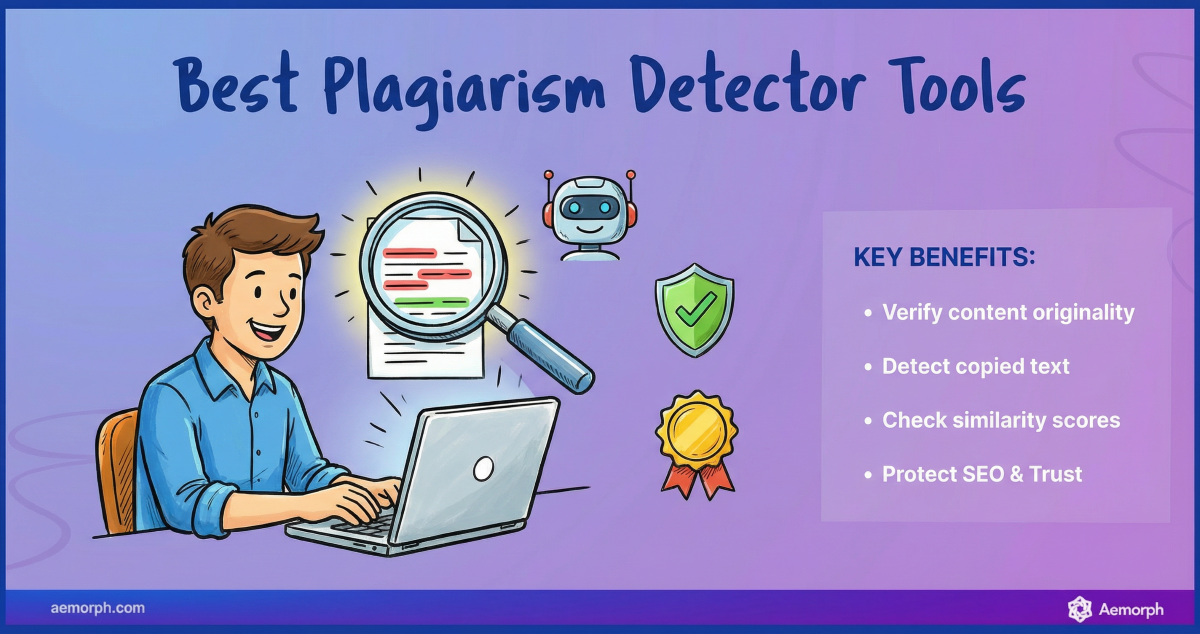
Plagiarism detector tools are software platforms that analyse text to identify copied, paraphrased, or unoriginal content by comparing it against large databases of web pages, academic sources, and proprietary repositories. Modern tools go beyond simple matching by incorporating AI detection, contextual analysis, and similarity scoring to assess content authenticity across different use cases.
As content production scales across SEO, academia, and AI-assisted writing, ensuring originality becomes a critical requirement rather than a quality check. Plagiarism detector tools help individuals and teams verify content integrity, reduce risk, and maintain trust by providing clear reports, source references, and actionable insights.
This guide reviews seven practical plagiarism detector tools used by students, content teams, businesses, and institutions.
Why Plagiarism Detector Tools Matter
Content is now produced faster than ever, especially with AI-assisted workflows. Without proper validation, duplicate or unoriginal content affects SEO performance, academic credibility, and brand trust.
Plagiarism detection tools provide a structured way to verify originality by analysing content against large datasets, identifying matches, and highlighting potential risks. They also help teams maintain consistency, reduce compliance issues, and improve overall content quality.
For businesses and content teams, plagiarism detection is no longer optional. It is part of the content production workflow.
Key Benefits of Using Plagiarism Detector Tools
- Identify copied or duplicated content
- Detect paraphrased or rewritten plagiarism
- Provide similarity scores and source references
- Support AI-generated content detection
- Improve content quality and credibility
- Reduce risk in SEO and publishing
- Enable scalable content validation workflows
1. PlagiarismDetector.net
Plagiarism is one of the fastest-growing issues that students, bloggers, researchers, and website owners have to face. With the vast amount of information available on the internet, it has become almost easy for everyone to copy content without realising it. This small act incurs significant academic penalties, negatively impacts SEO, or leads to a loss of credibility.
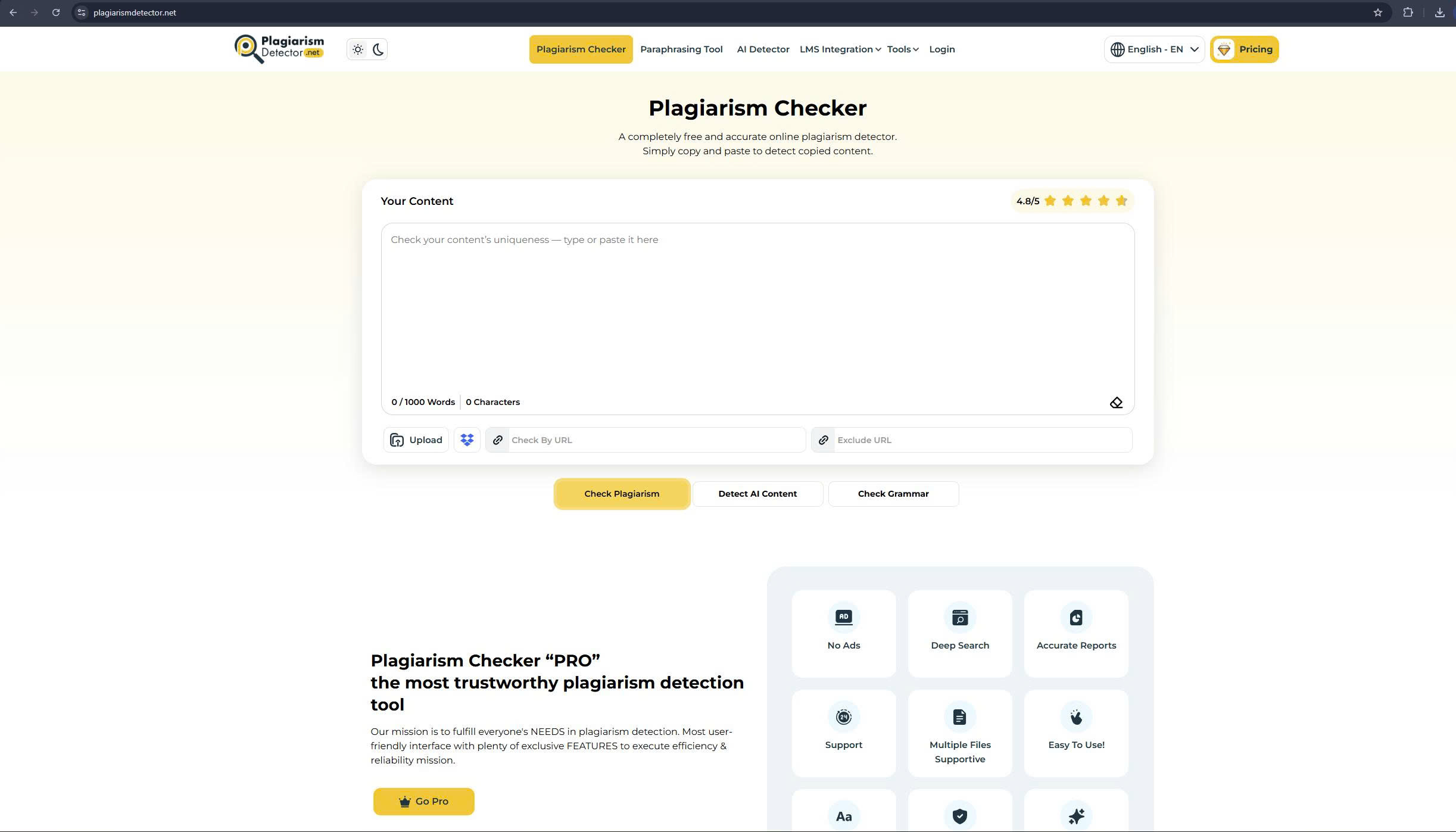
To avoid this issue, PlagiarismDetector.net became a safeguard for content creators. It helps users maintain the originality of their work by scanning their content against online sources. Many people use it to check essays, articles, and website pages before submitting or publishing them.
This online plagiarism tool helps in striking a balance between identifying copied content and protecting originality with utmost ease. Below are some features that explain how it simplifies plagiarism detection and enhances content quality.
- Web-Based Plagiarism Checking
- Text and Document Upload Support
- Matched Text Highlighted
- Source Link Detection
- Free and Paid Usage Alternatives
- Simple and Easy-to-Use Interface
- URL and File Upload Verification
- Multilingual Plagiarism Detection
Pricing and Suitability
PlagiarismDetector.net is fairly accurate in detecting copied text, whether exact or nearly exact, from publicly available websites. For example, when a paragraph is copied from a specific blog or online article, it is usually highlighted and accompanied by a link to the source. That is why this plagiarism detector is reliable in finding copy-paste plagiarism.
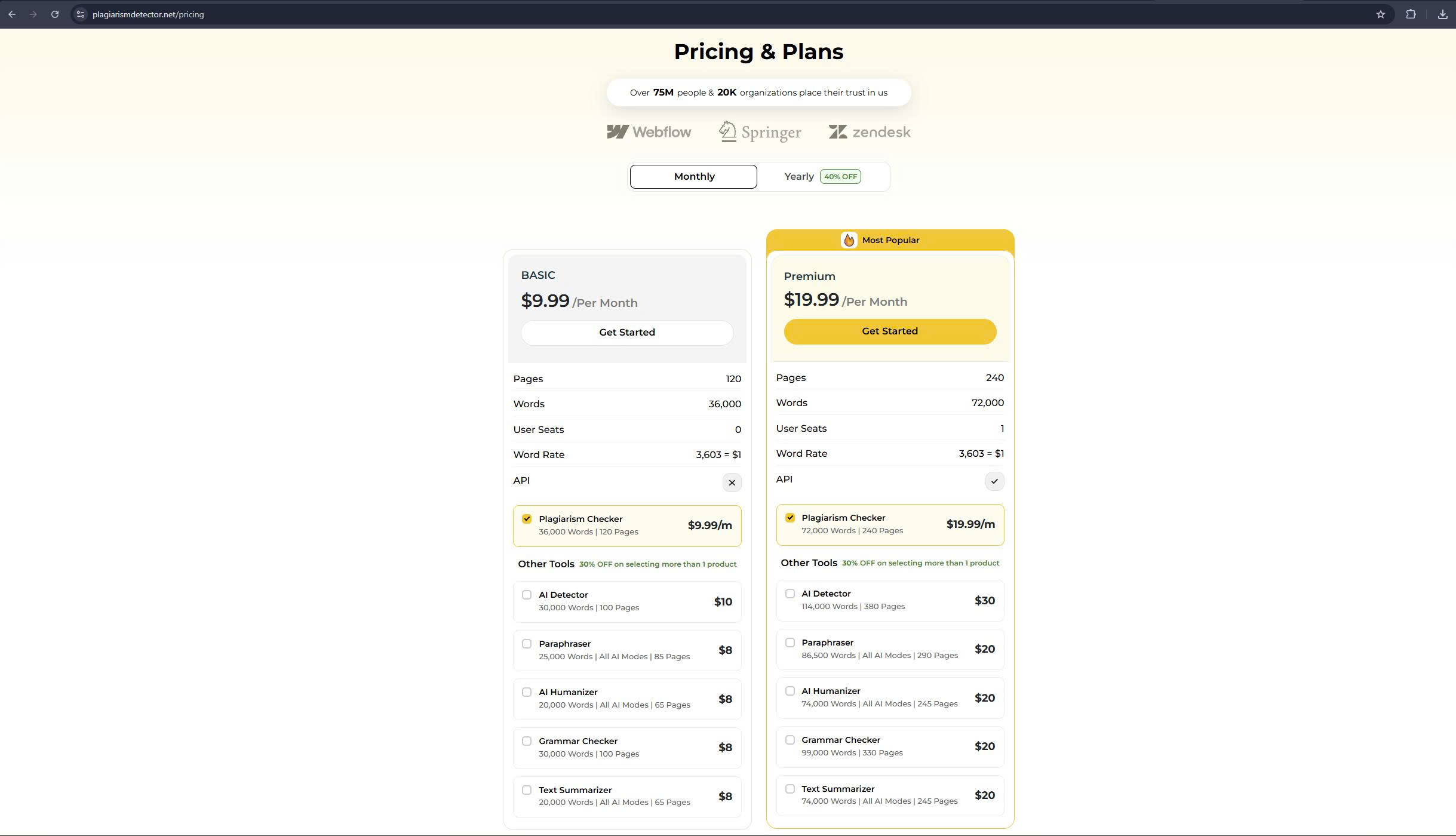
PlagiarismDetector.net uses a hybrid pricing model that combines a free tier with flexible paid plans based on word count and usage volume. The free version offers basic checks with limitations, such as lower word limits and reduced match visibility, while premium plans start at around $10 to $20 per month, with higher word allowances and deeper analysis. It is best suited for students, freelancers, and small teams who prioritise affordability and flexibility over deep academic accuracy.
2. Grammarly Plagiarism Checker
Grammarly is widely recognised as a writing assistant, but its plagiarism checker is integrated into a broader content-quality system that combines analysis of grammar, clarity, and originality. This makes it particularly useful for users who want an all-in-one solution rather than a standalone plagiarism tool.
It is commonly used by students, professionals, and content teams who prioritise usability and workflow efficiency. While it does not have the deepest academic database compared to specialised tools, its strength lies in ease of use and integration into everyday writing processes.
Core Features:
- Plagiarism detection across web sources
- Grammar and writing suggestions
- Integrated writing assistant
- Citation suggestions
- Real-time feedback
Pricing and Suitability
Grammarly’s plagiarism checker is not available as a standalone product; it is included in its premium plans. This positions it as a bundled solution rather than a dedicated detection platform.
| Plan | Price | Suitable For | Limitations |
| Free | USD 0 | Basic writing | No plagiarism checker |
| Premium | ~USD 12/month | Students & writers | Limited academic database |
| Business | ~USD 15/user/month | Teams | Higher cost for full access |
3. QuillBot Plagiarism Checker
QuillBot integrates plagiarism detection with paraphrasing and rewriting tools, making it especially relevant for users who need to both detect and fix plagiarism issues. This dual functionality positions it differently from traditional checkers.
It is commonly used by students and writers who work with rewritten or AI-assisted content. While its plagiarism detection is effective for general use, it is not as deep as academic-focused tools.
Core Features:
- Plagiarism detection
- Paraphrasing tool
- AI writing support
- Citation generator
- Multiple writing modes
Pricing and Suitability
QuillBot offers a flexible pricing model that combines writing and detection features into a single subscription, making it accessible to individual users.
| Plan | Price | Suitable For | Limitations |
| Free | USD 0 | Light use | Limited scans |
| Premium | ~USD 9.95/month | Students & writers | Limited database depth |
4. Scribbr Plagiarism Checker
Scribbr is known for using Turnitin’s database, giving it access to one of the largest academic content repositories. This makes it one of the most reliable tools for detecting academic plagiarism.
It is widely used by students, researchers, and institutions that require high accuracy and strong detection of paraphrased content. Its main limitation is pricing, as it operates on a per-document model.
Core Features:
- Deep academic database
- Turnitin-powered detection
- Detailed similarity reports
- Source comparison
- Citation support
Pricing and Suitability
Scribbr uses a one-time payment model based on document length, making it suitable for occasional but high-stakes checks.
| Words | Price | Suitable For | Limitations |
| <7,500 | ~USD 19.95 | Students | Expensive per use |
| <50,000 | ~USD 39.95 | Research papers | Not subscription-based |
5. Turnitin
Turnitin is the industry standard for academic plagiarism detection and is widely used by universities and institutions worldwide. Its database includes academic journals, student submissions, and proprietary content.
It is designed primarily for institutional use rather than individual users, thereby restricting access. However, it remains one of the most accurate tools available.
Core Features:
- Academic database access
- Similarity reports
- Institutional integration
- LMS compatibility
- Deep content analysis
Pricing and Suitability
Turnitin pricing is not publicly available and is typically licensed through institutions.
| Plan | Price | Suitable For | Limitations |
| Institutional | Custom | Universities | Not available for individuals |
6. GPTZero
GPTZero focuses on AI detection and also offers plagiarism-detection features. It is designed to identify AI-generated content alongside traditional plagiarism checks.
It is commonly used by educators and content reviewers who need to distinguish between human and AI-written text. However, AI detection accuracy varies depending on content complexity.
Core Features:
- AI detection
- Plagiarism detection
- Sentence-level analysis
- Probability scoring
- Reporting tools
Pricing and Suitability
GPTZero offers tiered plans based on usage volume, making it suitable for both individuals and teams.
| Plan | Price | Suitable For | Limitations |
| Free | USD 0 | Basic checks | Limited usage |
| Essential | ~USD 10/month | Students | Limited features |
| Premium | ~USD 16/month | Educators | AI detection variability |
7. Copyleaks
Copyleaks is a dedicated plagiarism and AI detection platform used by businesses, educational institutions, and enterprises. It offers strong detection capabilities across both web and proprietary databases.
It is particularly useful for organisations that require scalable content verification and API integrations. Its strength lies in combining accuracy with flexibility.
Core Features:
- Plagiarism detection
- AI content detection
- API integration
- Multi-language support
- LMS integration
Pricing and Suitability
Copyleaks pricing is based on credits, making it scalable but sometimes harder to estimate costs up front.
| Plan | Price | Suitable For | Limitations |
| Pay-as-you-go | ~USD 10/month | Small teams | Credit-based complexity |
| Enterprise | Custom | Large organisations | Pricing not transparent |
How to Choose the Right Plagiarism Detector Tool
Choosing the right tool depends on how you use content and the level of accuracy required. Different tools are designed for different use cases, from academic validation to SEO content verification.
Tools Comparison Matrix
| Tool | Best For | Strengths | Limitations |
| Grammarly | General writing | Easy to use | Limited database |
| QuillBot | Rewriting workflows | All-in-one | Less accurate |
| Scribbr | Academic use | High accuracy | Expensive |
| Turnitin | Institutions | Deep database | Restricted access |
| GPTZero | AI detection | AI-focused | Accuracy varies |
| Copyleaks | Enterprise | Scalable | Complex pricing |
| PlagiarismDetector.net | Quick checks / free use | Free access, easy to use | Limited database |
Conclusion
Plagiarism detector tools help ensure content originality across academic, professional, and SEO environments. By combining database scanning, AI detection, and similarity analysis, these platforms provide a reliable way to validate content before publishing or submission.
Each tool in this list serves a different purpose, from academic verification to AI content detection and enterprise workflows. Selecting the right platform depends on accuracy requirements, budget, and how content is produced within your organisation.
As organisations increasingly use AI to generate and deliver content in real time, maintaining originality extends beyond publishing and directly impacts customer-facing interactions. This is especially relevant for businesses using AI customer support tools, where ensuring accurate, non-duplicated responses is critical to maintaining trust and consistency at scale.
Originality supports rankings and trust. Read the content marketing guide, check duplicate pages with the on-page SEO audit and monitor the results with rank tracking tools.