International SEO structures your Australian business's overseas expansion around market-specific pages, localised content and signals that help search engines identify the right version for each country you sell into. The work comes down to four decisions: which overseas markets to target first, how to structure your URLs, how to flag each version to Google with hreflang, and how to localise the content and links for every market. Google picks the page to show in each locale from signals it reads on your site, so each of those decisions changes what an overseas buyer sees (Google Search Central, managing multi-regional and multilingual sites).
See Aemorph's international SEO service
What Is International SEO for an Australian Business?
For an Australian business, international SEO means ranking in the search results of every overseas country and language you sell into, as well as at home, with a page built for each market. Google draws a line between two situations. A multilingual site publishes content in more than one language; Google's own example is a Canadian business with English and French versions. A multi-regional site targets users in more than one country; Google's example is a manufacturer shipping to both Canada and the United States. Plenty of sites are both. For the first, Google matches the searcher's language; for the second, it matches the searcher's locale.
When Is International SEO the Right Move From Australia?
Start international SEO once your business sells to buyers outside Australia or in more than one language, because an Australia-only site sends those buyers to pages that were never written for them. Three triggers point to it: you ship or deliver beyond Australia, you serve customers here in more than one language, or you are preparing to launch in a new country and want demand in place on day one.
Three constraints shape the plan:
- Local search engines. Google does not lead search everywhere. In mainland China and South Korea, local engines such as Baidu and Naver carry a large part of search, so a plan built for Google alone reaches only part of those audiences.
- Language and culture. A literal translation misses local terms, spelling, currency and references, and overseas buyers notice the gap.
- Control. Local links, reviews and business listings sit with third parties in each market, so part of your result depends on work beyond your own website.
How Search Engine Share Differs at Home and Overseas
Search engine share in Australia looks nothing like share in some overseas markets, so check who leads search in each target country before you commit budget. At home, Google leads and Bing holds most of the rest, which is why Australian tracking covers Bing Webmaster Tools as well as Google Search Console. In South Korea, Naver sits within five percentage points of Google, and in Japan, Bing holds close to a third of the market.
| Measure | Figure | Market and date | Source |
|---|---|---|---|
| Google search engine market share | 87.9% | Australia, September 2026 | StatCounter |
| Bing search engine market share | 9.17% | Australia, September 2026 | StatCounter |
| Google search engine market share | 47.97% | South Korea, September 2026 | StatCounter |
| Naver search engine market share | 43.06% | South Korea, September 2026 | StatCounter |
| Bing search engine market share | 31.41% | Japan, September 2026 | StatCounter |
Sources: StatCounter Global Stats, search engine market share, Australia, South Korea and Japan, September 2026.
How Does International SEO Differ From Local SEO in Australia?
Local SEO wins buyers near one Australian location, while international SEO wins buyers across whole countries or languages, so the two differ in scale, competition and budget.
| Factor | Local SEO | International SEO | What changes for you | Typical first step |
|---|---|---|---|---|
| Target area | A suburb, city or service area in Australia | One or more overseas countries or languages | Each market gets its own pages | Choose the first overseas market |
| Main signals | Business Profile, local listings, reviews | URL structure, hreflang, localised content and local links | Technical set-up matters more | Audit your current locale signals |
| Competition | Businesses near you | National and global brands in each market | More pages and links per market | Check who ranks in each target country |
| Resources | Content and listings for one market | Content, links and listings for every market | Budget grows with each market added | Cost one market before adding the next |
| Measurement | Local pack and map rankings | Rankings and traffic by country | Reporting splits by market | Add country filters in Search Console and check Bing Webmaster Tools |
Local and international SEO compared for an Australian business.
How Do You Do International SEO From Australia?
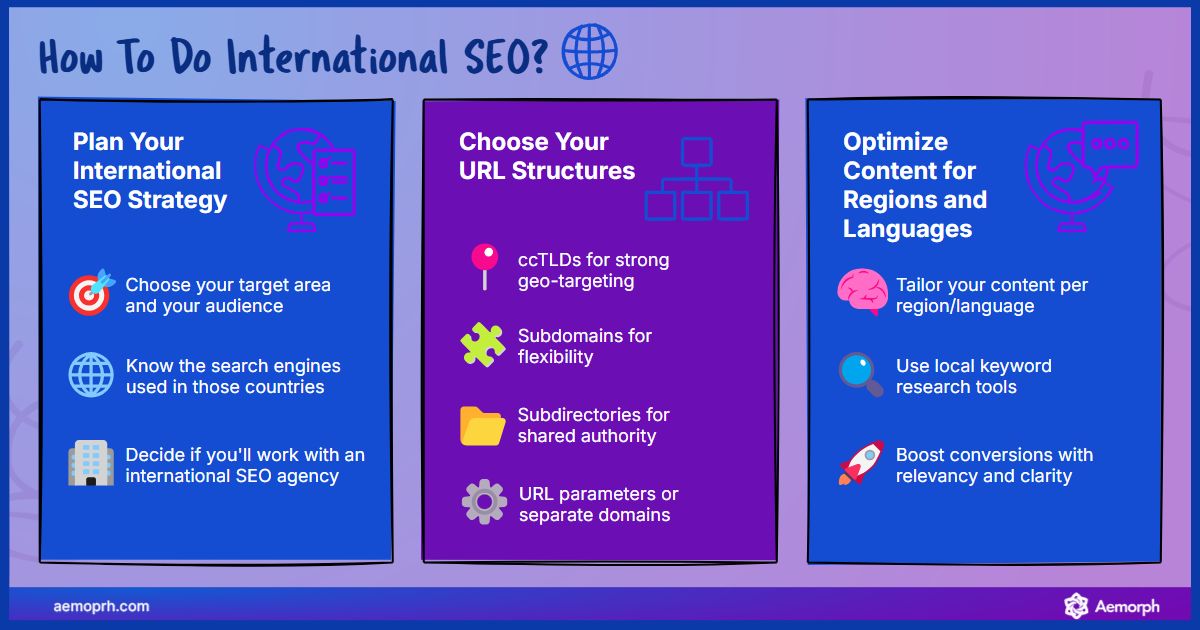
Run international SEO in three steps, plan the markets, choose the URL structure, then localise content for each region and language, because each step lowers the cost of the next.
1. Plan your international SEO strategy from Australia
Plan before you build, because the overseas markets you pick set your URL structure, your keyword research and your budget. Work through four questions for each market:
- Which countries and languages? Rank the overseas markets by revenue potential.
- Which search engines? Check whether Google leads in each market or a local engine does.
- Which keywords? Research the words buyers use in each market, in their own language and spelling. Buyers in another English-speaking country often use different terms and spellings from Australian buyers, so research each market rather than reusing your Australian keyword list.
- Who does the work? Choose between your in-house team and an agency. An agency brings specialist experience in hreflang, URL structures and local link building; your own team retains day-to-day control. Compare agency fees with fully loaded staffing, training and tool costs. If no one on your team has run an international project before, outside help shortens the learning curve.
2. Choose your URL structure
Your URL structure signals to Google and to buyers which country or language each page serves, so settle it before any overseas page goes live. Google recommends a separate URL for each language version instead of cookies or browser settings that swap the language on one URL, because Googlebot usually crawls from the USA and sends requests without a language preference (Google Search Central).
| Structure | Example | Pros (per Google) | Cons (per Google) | Best for |
|---|---|---|---|---|
| Country-specific domain (ccTLD) | example.de | Clear geotargeting; server location irrelevant; sites easy to separate | Costly and not always available; more infrastructure; strict ccTLD rules in some countries; one country per domain | Businesses with a local entity and budget in each country |
| Subdomain on a gTLD | de.example.com | Simple set-up; different server locations possible; sites easy to separate | Users do not always read the targeting from the URL alone | Teams running each market as its own site |
| Subdirectory on a gTLD | example.com/de/ | Simple set-up; low maintenance on one host | Users do not always read the targeting from the URL alone; one server location; harder to separate | Most Australian businesses entering their first overseas markets |
| URL parameters | site.com?loc=de | None listed | Not recommended by Google; segmentation is difficult | Avoid |
| Separate brand domains | examplefrance.com | Clear market branding | Each domain builds authority alone; higher cost; duplicate content risk | Brands trading under a different name overseas |
URL structure options. Source: Google Search Central, managing multi-regional and multilingual sites, last updated December 2025. The separate brand domain row reflects general practice and is not part of Google's table.
How does Google decide which country a page targets?
Google weighs several signals to set a page's target locale: the ccTLD, hreflang, server location and local signals such as addresses, phone numbers, language, currency, links from local sites and your Business Profile. Google treats some ccTLDs, such as .tv, .me, .io and .co, as generic domains, and treats regional domains such as .eu and .asia as generic too. A .com.au domain signals Australia; that signal is not a prohibition on overseas rankings. For dedicated overseas targeting, Aemorph recommends a gTLD with market-specific URLs or the target country's ccTLD. Google ignores locational meta tags such as geo.position and geotargeting HTML attributes.
3. Optimise content for each overseas region and language
Write each overseas page for its own market instead of translating your Australian page word for word, so it uses the terms, spelling, currency and references buyers there expect. Google works out a page's language from its visible content, not from lang attributes or the URL, so keep one language per page across content and navigation, and avoid side-by-side translations.
- Localise, then translate. Begin with each market's keyword research, then write or adapt the page.
- Let buyers switch. Link each page to its other language versions, and never redirect visitors automatically on a guess about their language, because that hides versions from users and search engines.
- Handle duplicates. Where two markets share a language, such as Australia and New Zealand, choose a preferred version for any near-identical page and use rel="canonical" together with hreflang, as Google advises.
What is hreflang?
Hreflang is an annotation that tells Google which language and regional version of a page serves which audience. It combines a language code with an optional region code, such as en-AU or en-NZ, from the ISO 639-1 and ISO 3166-1 alpha-2 standards, and sits in the page's HTML head, an HTTP header or your sitemap (Google Search Central, localised versions). Each version lists itself and every alternate, each linked page links back, and an x-default page catches searchers who match no listed version. Google ignores hreflang pairs that do not point to each other.
Which Practices Make International SEO Work for Australian Businesses?
Seven practices keep your overseas pages ranking, and each one closes a gap that otherwise sends buyers to the wrong page or to a local competitor.
- Build one version per language and market. Give each its own URL and join the set with hreflang.
- Localise content. Use the market's language, spelling, currency, examples and contact details, not Australian defaults.
- Research keywords per market. Base every page on what buyers in that country search.
- Earn local links. Links from websites in each country are one of the locale signals Google reads, so approach local publications, partners and associations there.
- Optimise for local search engines. Where a local engine leads, follow its own webmaster guidelines.
- Make every version mobile-friendly. Test each market's pages on a phone, since buyers in every market search on mobile.
- Monitor results per country. Filter Google Search Console by country, check Bing Webmaster Tools, and track rankings for each market on its own.
Common Questions About International SEO From Australia
These questions cover cost against benefit, timing and the obstacles to overseas search visibility.
Is international SEO worth it for an Australian business?
International SEO pays off once buyers, delivery and support are ready in the overseas market, because rankings there only return value if you serve the enquiries they bring. Every market adds content, technical and link work. Start with one overseas market, measure the enquiries it produces, then add the next.
How long does international SEO take to work?
Timing depends on the competition in each overseas market and on how many pages are new. Your first ranking movements show within 45 days of publishing. The clock starts when the overseas pages go live, not when the project starts. See the international SEO service for how Aemorph runs it.
Source: results reported in past client testimonials. Watch the client videos
What are the most common obstacles in international SEO?
Four obstacles to check for on any overseas project are missing market keyword research, broken hreflang, pages that fail on mobile, and content that is translated but not localised.
| Obstacle | What goes wrong | Effect on your buyers | Fix | Check |
|---|---|---|---|---|
| No market keyword research | Pages target terms nobody in that market searches | Overseas buyers never find the page | Research each market in its own language | Search Console queries by country |
| Broken hreflang | Return links or codes are missing | Overseas buyers land on your Australian page | List every version on every page, with return links and x-default | Crawl report of hreflang errors |
| Not mobile-friendly | Pages break on small screens | Buyers leave before they enquire | Test every market's templates on a phone | PageSpeed Insights on mobile |
| Translated, not localised | Wording, spelling and currency read as Australian or foreign | Buyers trust the page less | Adapt examples, currency and contact details | Review by a native speaker in the market |
Four common obstacles and their fixes.
Putting International SEO in Place From Australia
International SEO is ongoing: you monitor each overseas market, fix what drifts and add markets one at a time, so each expansion reuses the same technical framework while rankings and enquiries are measured market by market. Hreflang, canonical tags and crawl checks belong in every on-page SEO audit, and local link building follows the tactics in the off-page SEO guide. Research each market with keyword research. For the same guide without an Australian starting point, read the global international SEO guide.
To run it with a team that has done it before, see Aemorph's international SEO service. Aemorph is headquartered in Singapore, has no office in Australia and works with Australian clients remotely, in Australian business hours.