When your Singapore business expands overseas, international SEO gives each new country a page made for its market, with the signals that help Google tell that page apart from the one you wrote for Singapore. It turns on four choices: the overseas markets you enter first, the URL structure that holds them, the hreflang tags that tell Google which version serves which audience, and the local content and links each market needs. Google decides which page to rank for each locale from signals on your site, so every one of these choices shapes what a buyer abroad sees (Google Search Central, managing multi-regional and multilingual sites).
See Aemorph's international SEO service
What Is International SEO for a Singapore Business?
International SEO is how a Singapore business earns rankings in each overseas country and language it serves, so every market lands on a page written for it rather than on the home-market page. Google sorts sites into two cases. A multilingual site carries content in more than one language, as in Google's example of a Canadian business with English and French versions. A multi-regional site aims at users in different countries, as in Google's example of a manufacturer selling into Canada and the United States. A site is often both at once. In the first case Google matches the searcher's language; in the second, the searcher's locale.
When Is International SEO the Right Move From Singapore?
International SEO becomes worth the effort once you sell beyond Singapore or in more than one language, since a site built for one market leaves overseas buyers on pages that do not address them. It fits three situations: you deliver to customers in other countries, you serve customers in Singapore in more than one language, or you are planning a new market entry and want search demand waiting when you open.
Three limits shape the plan:
- Local search engines. Not every market runs on Google. In mainland China and South Korea, local engines such as Baidu and Naver carry a large part of search, so a Google-only plan misses much of those audiences.
- Language and culture. Word-for-word translation misses the local terms, spelling, currency and references buyers expect, and they spot it.
- Control. Local links, reviews and listings belong to third parties in each country, so part of the outcome rests on work outside your own site.
How Search Engine Share Compares in Singapore and Overseas
Singapore's search market is close to a Google-only market, while some overseas markets split search across several engines, so confirm the leading engine in each country you target. Google held 92.16% of search engine market share in Singapore in September 2026 (StatCounter). In mainland China in the same month, Baidu led and Google held under 2%, so a plan for China starts from a different engine altogether.
| Measure | Figure | Market and date | Source |
|---|---|---|---|
| Google search engine market share | 92.16% | Singapore, September 2026 | StatCounter |
| Bing search engine market share | 4.53% | Singapore, September 2026 | StatCounter |
| Internet users | 5.78 million, 98.4% of the population | Singapore, as of October 2025 | DataReportal |
| Baidu search engine market share | 46.65% | China, September 2026 | StatCounter |
| Google search engine market share | 1.46% | China, September 2026 | StatCounter |
Sources: StatCounter Global Stats, search engine market share, Singapore and China, September 2026; DataReportal, Digital 2026: Singapore, data as of October 2025.
How Does International SEO Differ From Local SEO in Singapore?
Local SEO targets buyers around one Singapore address, and international SEO targets buyers across entire countries or languages, so scale, competition and resourcing all change.
| Factor | Local SEO | International SEO | What changes for you | Typical first step |
|---|---|---|---|---|
| Target area | A neighbourhood, district or service area in Singapore | One or more overseas countries or languages | Every market needs pages of its own | Select the markets |
| Main signals | Business Profile, local listings, reviews | URL structure, hreflang, market content and local links | Technical set-up weighs more | Audit the locale signals you have today |
| Competition | Businesses close by | National and international brands in each country | More pages and links for every market | See who ranks in each target country |
| Resources | Content and listings for Singapore | Content, links and listings for each market | Budget rises with every market added | Cost a single market before adding more |
| Measurement | Local pack and map rankings | Rankings and traffic by country | Reports split per market | Set country filters in Search Console |
Local and international SEO compared for a Singapore business.
How Do You Do International SEO From Singapore?
Treat international SEO as three steps, plan the markets, settle the URL structure, then adapt content for each region and language, since each step makes the following one cheaper.
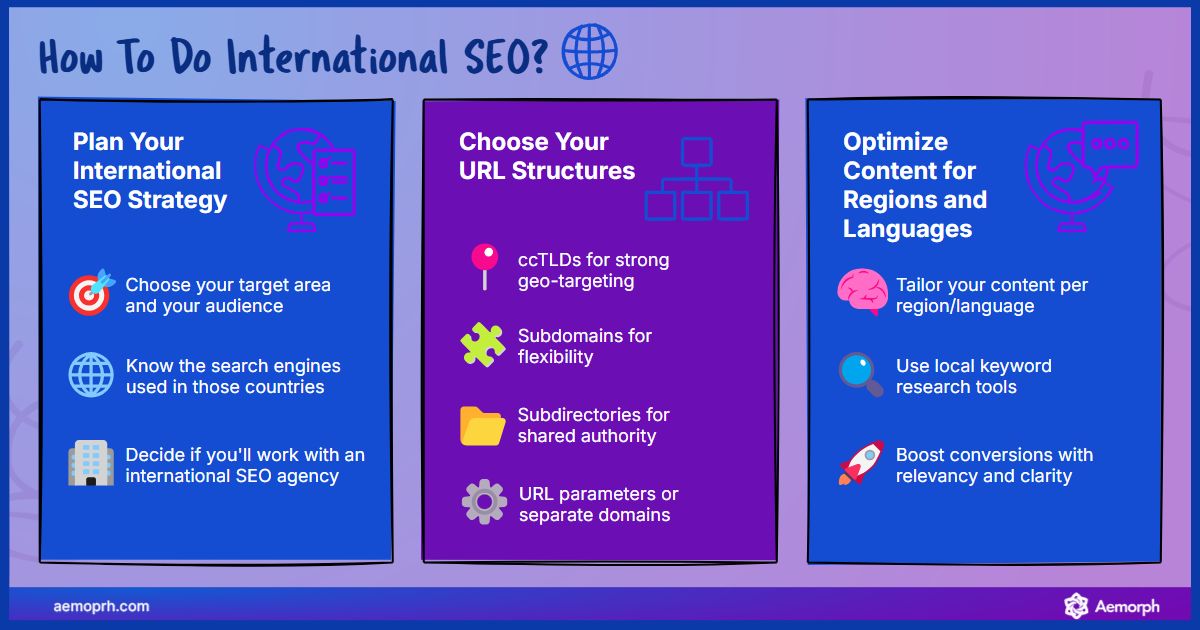
1. Plan your international SEO strategy from Singapore
Plan first, because the overseas markets you choose fix your URL structure, your keyword research and your budget. Answer four questions per market:
- Which countries and languages? Order the overseas markets by revenue potential.
- Which search engines? Find out whether Google or a local engine leads in each market.
- Which keywords? Research the phrases buyers use in each market, in their language and their spelling. Even in another English-speaking country, buyers search with their own terms, so build a keyword list per market instead of copying your Singapore one.
- Who does the work? Weigh your in-house team against an agency. An agency brings hreflang, URL structure and local link building experience; your own team keeps control. Compare your team's skills, capacity and fully loaded costs with the agency's quoted scope. If your team has never run an international project, outside help shortens the learning curve.
2. Choose your URL structure
The URL structure tells Google and buyers which country or language a page is for, so decide it before any overseas page is published. Google recommends distinct URLs for each language version rather than cookies or browser settings that switch the language on a single URL, because Googlebot usually crawls from the USA and sends requests without a language preference (Google Search Central).
| Structure | Example | Pros (per Google) | Cons (per Google) | Best for |
|---|---|---|---|---|
| Country-specific domain (ccTLD) | example.de | Clear geotargeting; server location irrelevant; sites simple to keep apart | Expensive and limited in availability; more infrastructure; strict ccTLD requirements in some countries; aimed at one country only | Businesses with a local entity and budget in each country |
| Subdomain on a gTLD | de.example.com | Quick to set up; server locations vary by subdomain; sites simple to keep apart | The URL alone does not always show users the targeting | Teams that operate each market as a separate site |
| Subdirectory on a gTLD | example.com/de/ | Quick to set up; little maintenance on one host | The URL alone does not always show users the targeting; one server location; sites harder to keep apart | Most Singapore businesses entering their first overseas markets |
| URL parameters | site.com?loc=de | None listed | Google does not recommend them; segmentation is hard | Avoid |
| Separate brand domains | examplefrance.com | Clear market branding | Authority builds separately on each domain; more cost; duplicate content risk | Brands with a distinct local name in each market |
URL structure options. Source: Google Search Central, managing multi-regional and multilingual sites, last updated December 2025. The separate brand domain row is general practice, not part of Google's table.
How does Google decide which country a page targets?
Google combines several signals to set a page's target locale: the ccTLD, hreflang annotations, server location and local cues such as addresses, phone numbers, language, currency, links from sites in that country and your Business Profile. Some ccTLDs, including .tv, .me, .io and .co, count as generic domains for Google, as do regional domains such as .eu and .asia. A .sg domain strongly signals Singapore, and pages on it remain eligible to rank overseas; for multi-country expansion, Aemorph recommends a gTLD with market folders or a separate ccTLD for each target country. Google disregards locational meta tags such as geo.position and geotargeting HTML attributes.
3. Optimise content for each overseas region and language
Write every overseas page for the market it serves rather than translating the Singapore page line by line, so the page carries the terms, spelling, currency and references local buyers expect. Google identifies a page's language from its visible content, not from lang attributes or the URL, so keep each page, content and navigation alike, in one language and avoid side-by-side translations.
- Localise first, translate second. Start from the market's keyword research, then write or adapt the page.
- Give buyers a switch. Link each page to its other language versions, and never auto-redirect visitors on an assumption about their language, since that stops users and search engines from reaching every version.
- Deal with duplicates. Where two markets share a language, such as Singapore and the United Kingdom, nominate a preferred version for any near-identical page and pair rel="canonical" with hreflang, as Google advises.
What is hreflang?
Hreflang is an annotation that tells Google which language and regional version of a page serves which audience. It joins a language code to an optional region code, for example en-SG or zh-SG, using the ISO 639-1 and ISO 3166-1 alpha-2 standards, and goes in the page's HTML head, an HTTP header or the sitemap (Google Search Central, localised versions). Each version names itself and every alternate, every linked page links back, and an x-default page picks up searchers who fit no listed version. Google ignores hreflang pairs that do not point to each other.
Which Practices Make International SEO Work for Singapore Businesses?
Seven practices keep overseas pages ranking, and each one shuts a gap that otherwise leaves buyers on the wrong page or with a rival.
- One version per language and market. Give each version its own URL and tie the set together with hreflang.
- Localise the content. Use each market's language, spelling, currency, examples and contact details instead of Singapore defaults.
- Keyword research per market. Build each page on what buyers in that country type.
- Local links. Links from sites in each country are one of the locale signals Google reads, so reach out to publications, partners and associations in that market.
- Local search engines. Where a local engine leads, follow its own webmaster guidelines.
- Mobile-friendly versions. Test every market's pages on a phone, since buyers in every market search on mobile.
- Country-level monitoring. Filter Google Search Console by country and track each market's rankings separately.
Common Questions About International SEO From Singapore
The answers below cover cost against return, timing and obstacles to overseas search visibility.
Is international SEO worth it for a Singapore business?
International SEO earns its cost when buyers, delivery and support are already in place in the new market, because overseas rankings return value only when you handle the enquiries they create. Each market adds content, technical and link work. Enter one overseas market first, measure its enquiries, then move to the next.
How long does international SEO take to work?
Timing turns on the competition in each overseas market and the number of new pages. Your first ranking movements show within 45 days of publishing. The count begins when the overseas pages are published, not when planning begins. The international SEO service shows how Aemorph runs it.
Source: results reported in past client testimonials. Watch the client videos
What are the most common obstacles in international SEO?
Four problems to check for are missing market keyword research, broken hreflang, poor mobile usability and translation without localisation.
| Obstacle | What goes wrong | Effect on your buyers | Fix | Check |
|---|---|---|---|---|
| No market keyword research | Pages chase terms no one in the market searches | Buyers abroad never reach the page | Research every market in its own language | Search Console queries by country |
| Broken hreflang | Return links or codes go missing | Buyers abroad land on your Singapore page | Name every version on every page, with return links and x-default | Crawl report of hreflang errors |
| Not mobile-friendly | Pages break on small screens | Buyers leave before enquiring | Test each market's templates on a phone | PageSpeed Insights on mobile |
| Translated, not localised | Wording, spelling and currency feel out of place | Buyers trust the page less | Adjust examples, currency and contact details | Review by a native speaker in the market |
Four common obstacles and their fixes.
Putting International SEO in Place From Singapore
International SEO keeps running after launch: you watch each overseas market, correct drift and add markets one by one, so each expansion reuses the technical framework while rankings and enquiries are measured separately in every market. Hreflang, canonical tags and crawl checks belong in every on-page SEO audit, and local link building follows the off-page SEO guide. Research each market with keyword research. For the version of this guide without a Singapore starting point, read the global international SEO guide.
To run it with a team that has done it before, see Aemorph's international SEO service.