









AI marketing automation tools help businesses coordinate marketing decisions across channels, campaigns, and customer lifecycle stages. These platforms use artificial intelligence to analyse customer behaviour, prioritise actions, and trigger marketing responses at scale. Instead of relying on fixed rules, they adapt engagement based on signals such as timing, intent, and past interactions. This makes them essential for businesses managing complex marketing operations across email, web, mobile, and paid channels.
For SMEs and growing organisations, AI marketing automation reduces manual decision-making while improving consistency and relevance. These systems guide when to engage, which channel to use, and how journeys should progress across the funnel. This article explains why AI marketing automation matters, how these platforms differ from basic automation, and which tools businesses rely on in 2026.
Why AI Marketing Automation Tools Matter for Business Growth
As marketing operations expand, teams face fragmented data, overlapping campaigns, and inconsistent customer experiences. AI marketing automation tools address this by acting as a coordination layer across the entire marketing funnel. They connect customer data with decision logic, allowing businesses to manage engagement as a system rather than as isolated campaigns.
Traditional marketing automation follows predefined rules and static workflows. AI marketing automation uses behavioural data and predictive models to dynamically adjust actions. Instead of sending the same message to every contact in a segment, these platforms evaluate likelihood, intent, and timing before acting.
This shift allows marketing teams to manage journeys that adapt as customers move through the funnel. Decisions are guided by probability and signals rather than rigid logic, improving relevance without increasing operational load.
Key benefits for businesses include:
- Coordinated marketing decisions across channels
- Improved timing and relevance of engagement
- Reduced reliance on manual prioritisation
- Scalable lifecycle management
- Clearer performance accountability
These outcomes help teams maintain control as marketing complexity grows.
1. ActiveCampaign
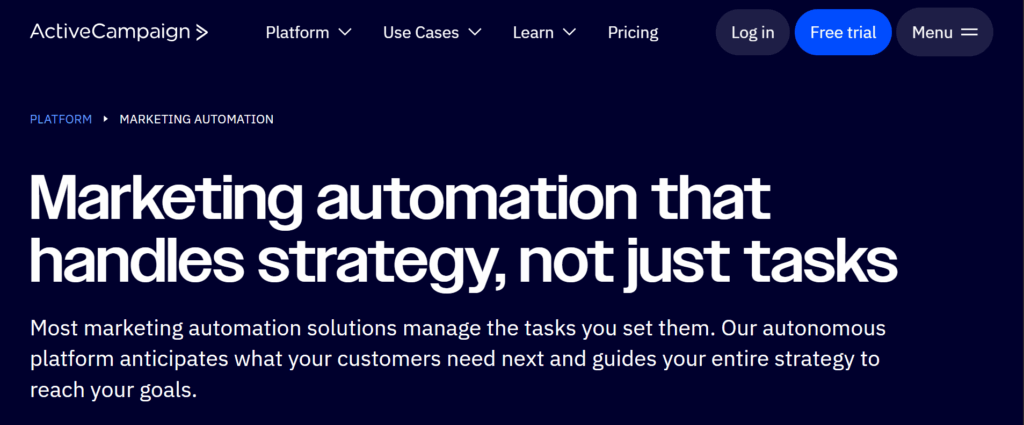
ActiveCampaign supports AI-driven lifecycle orchestration for businesses that manage ongoing customer engagement across multiple touchpoints. The platform combines automation with predictive insights that help teams prioritise contacts, adjust engagement timing, and guide customers through structured journeys. Its design supports coordinated decision-making across the lifecycle rather than one-off campaign execution.
ActiveCampaign is often used by SMEs and growing teams that need control over engagement flow without building complex systems from scratch. By focusing on lifecycle progression and behaviour-based triggers, the platform helps marketing teams manage consistent communication as customer volumes and channel usage increase.
Pricing plans
ActiveCampaign offers tiered pricing that scales based on contact volume and feature access. Entry plans suit SMEs starting with lifecycle automation, while higher tiers support more advanced orchestration and reporting. Pricing increases as databases grow, which businesses should account for when planning long-term use.
| Plan | Starting price (USD/month) | Included features | Limitations |
| Starter | From 15 | Core email marketing, basic automation, forms | Limited reporting and advanced segmentation |
| Plus | From 49 | Enhanced automation, CRM features, and customer insights | Advanced analytics gated to higher tiers |
| Pro | From 79 | Predictive sending, advanced reporting, and custom workflows | Costs rise quickly with contact growth |
| Enterprise | From 145 | Enterprise support, advanced controls | Pricing varies by database size |
2. Salesforce Einstein

Salesforce Einstein acts as the AI intelligence layer within Salesforce’s marketing ecosystem. It supports predictive scoring, forecasting, and decision prioritisation across marketing and sales activities. Instead of managing message execution, Einstein informs which actions are most likely to drive outcomes based on historical data and behavioural signals.
Einstein is designed for organisations operating at scale, where marketing decisions need to align closely with sales activity and revenue forecasting. Its role centres on guiding prioritisation and optimisation across complex systems, making it suitable for enterprises that rely on data-driven coordination rather than manual judgement.
Pricing plans
Einstein pricing depends on Salesforce product editions and add-ons. Businesses typically purchase Einstein capabilities alongside Marketing Cloud or Account Engagement products. Costs reflect enterprise-scale use and are billed annually.
| Plan or add-on | Price | Included features | Limitations |
| Marketing Cloud Growth | 1,500 per org/month | Core Marketing Cloud with AI foundations | Limited advanced personalisation |
| Marketing Cloud Advanced | 3,250 per org/month | Expanded orchestration and analytics | Add-ons often required |
| Einstein Engagement | From 1,750 per month | Predictive engagement and optimisation | Requires Marketing Cloud |
| Einstein Personalisation | 96,000 per year | Web personalisation and AI decisioning | Enterprise purchase only |
3. Adobe Marketo Engage
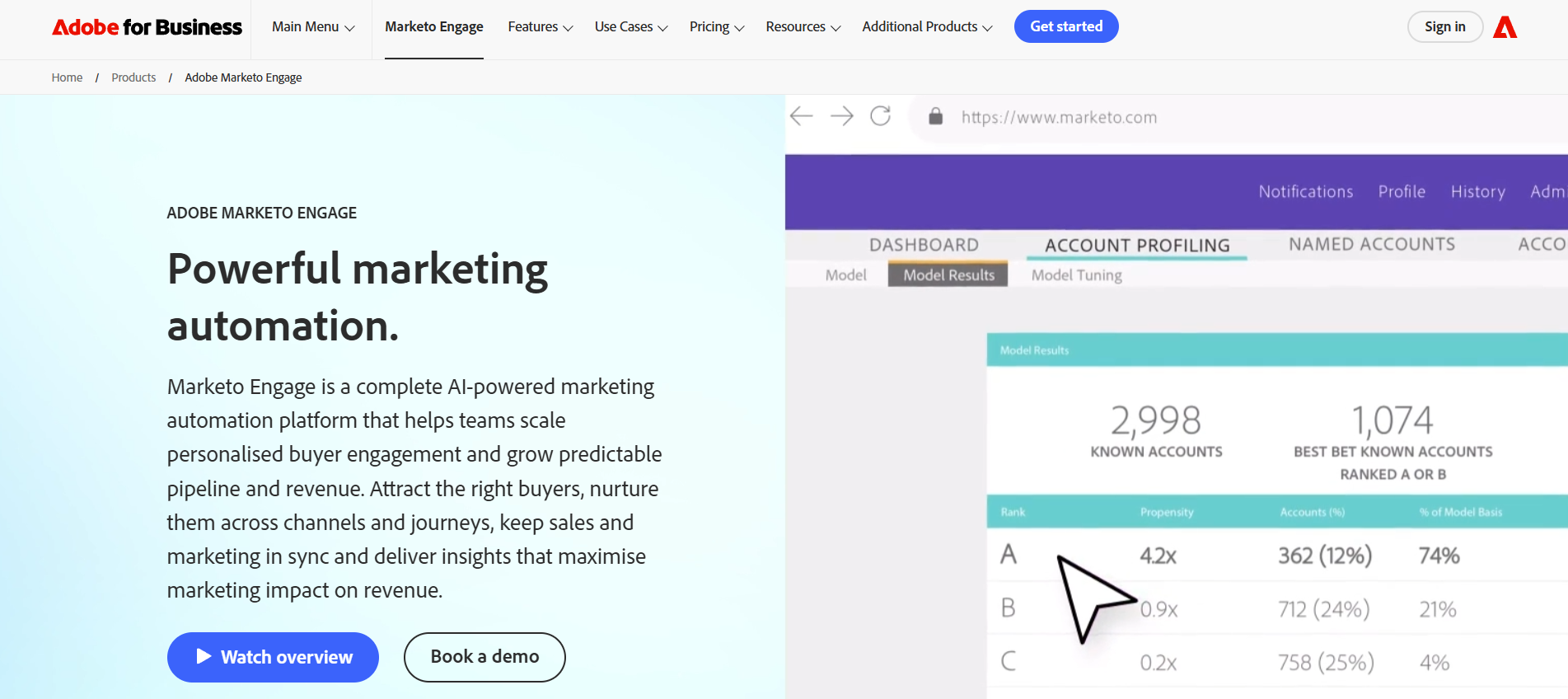
Adobe Marketo Engage supports B2B marketing automation at scale, with a strong focus on long buying cycles and complex decision-making processes. The platform is designed for organisations that manage account-based strategies, multi-stakeholder journeys, and governed marketing operations. It helps teams coordinate engagement across extended funnels where timing, scoring, and progression require close control.
Marketo Engage emphasises structured lifecycle management rather than isolated campaign execution. AI-assisted features support lead scoring, prioritisation, and journey progression, enabling marketing teams to guide prospects through complex funnels in a controlled, measurable way. This approach suits enterprises with defined processes, clear governance requirements, and dedicated marketing operations teams.
Pricing plans
Adobe does not publish fixed pricing for Marketo Engage. Packages are sold through customised contracts based on database size and feature requirements. This model suits enterprises with defined marketing operations.
| Package | Price | Included features | Limitations |
| Select | Custom | Core B2B automation and lifecycle tools | Pricing not publicly listed |
| Prime | Custom | Advanced scoring and journey management | Contract-based features |
| Ultimate | Custom | Full orchestration and analytics | Add-ons may apply |
| Enterprise | Custom | Large-scale governance and control | Quote required |
4. Braze

Braze focuses on real-time, behaviour-driven marketing orchestration for businesses that rely on live customer interactions. The platform processes customer signals as they occur, using events to guide engagement timing, channel selection, and message delivery. This structure supports adaptive journeys that respond immediately to changes in user behaviour.
Braze is commonly used in environments where customer activity generates frequent events, such as mobile apps, subscription platforms, and digital services. Its orchestration model allows teams to coordinate engagement across channels while maintaining responsiveness and consistency. Rather than managing static campaigns, teams use Braze to guide engagement decisions in real time.
Pricing plans
Braze uses a sales-led pricing model based on usage and deployment scope. Costs typically reflect monthly active users and messaging volume. Public pricing is not disclosed.
| Plan | Price | Included features | Limitations |
| Braze Platform | Custom | Real-time orchestration, journey tools, analytics | No public pricing grid |
| Typical entry range | Custom estimate | Mid-scale deployments | Final cost varies by usage |
5. Omnisend
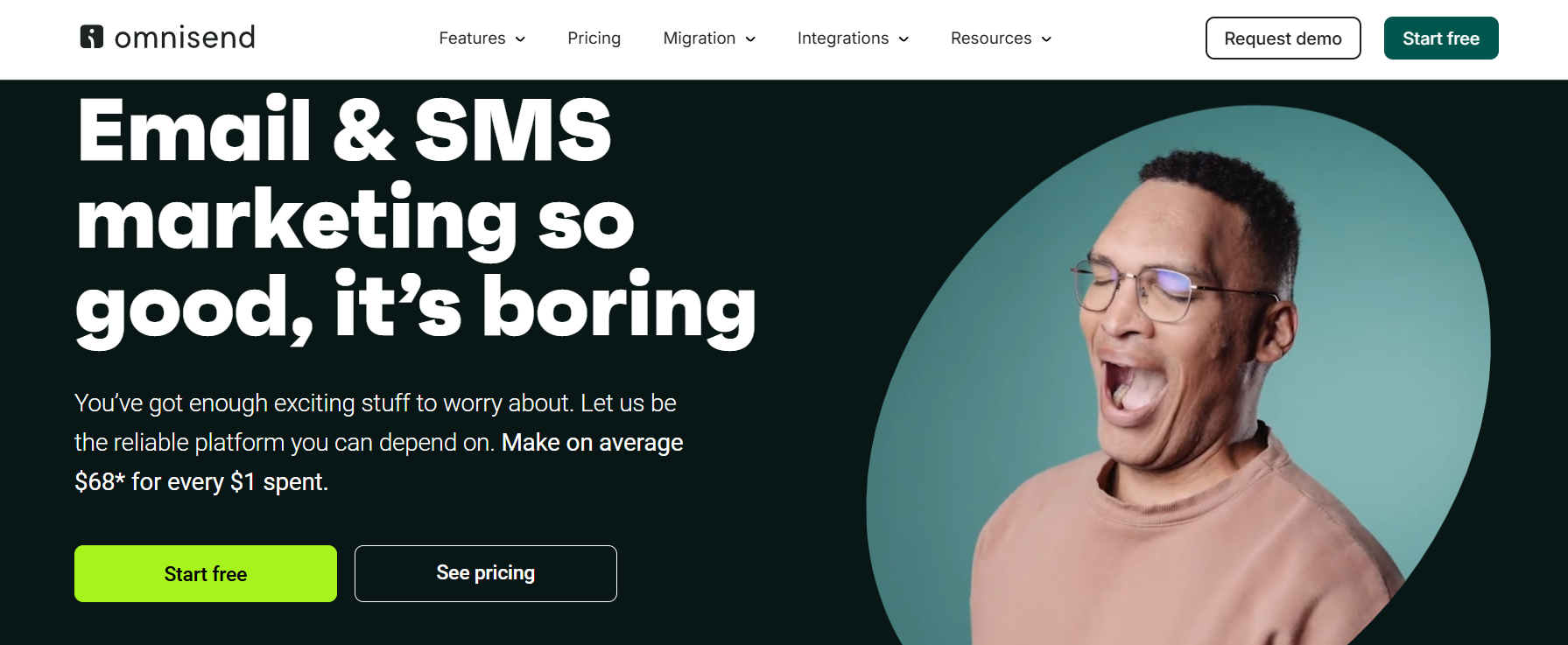
Omnisend provides AI-driven marketing orchestration tailored for e-commerce businesses that manage frequent customer interactions and transactions. The platform supports purchase-based triggers and lifecycle coordination across customer touchpoints, enabling teams to respond to shopping behaviour in a timely, structured way. This approach helps businesses align engagement decisions with how customers browse, buy, and return.
Omnisend focuses on coordinating marketing actions around transaction signals rather than isolated campaigns. Its orchestration logic supports consistent engagement across the customer lifecycle, from first purchase through repeat orders and retention stages. This makes the platform suitable for online retailers seeking to manage growth without increasing operational complexity.
Pricing plans
Omnisend publishes clear pricing tiers based on contact volume and messaging limits. Entry plans support early e-commerce growth, while higher tiers handle increased scale.
| Plan | Price (USD/month) | Included features | Limitations |
| Free | 0 | Core features, limited contacts | 500 emails per month |
| Standard | From 16 | Full feature access, increased limits | Pricing scales with list size |
| Pro | From 59 | High-volume sending, SMS support | Higher cost at scale |
6. Customer.io
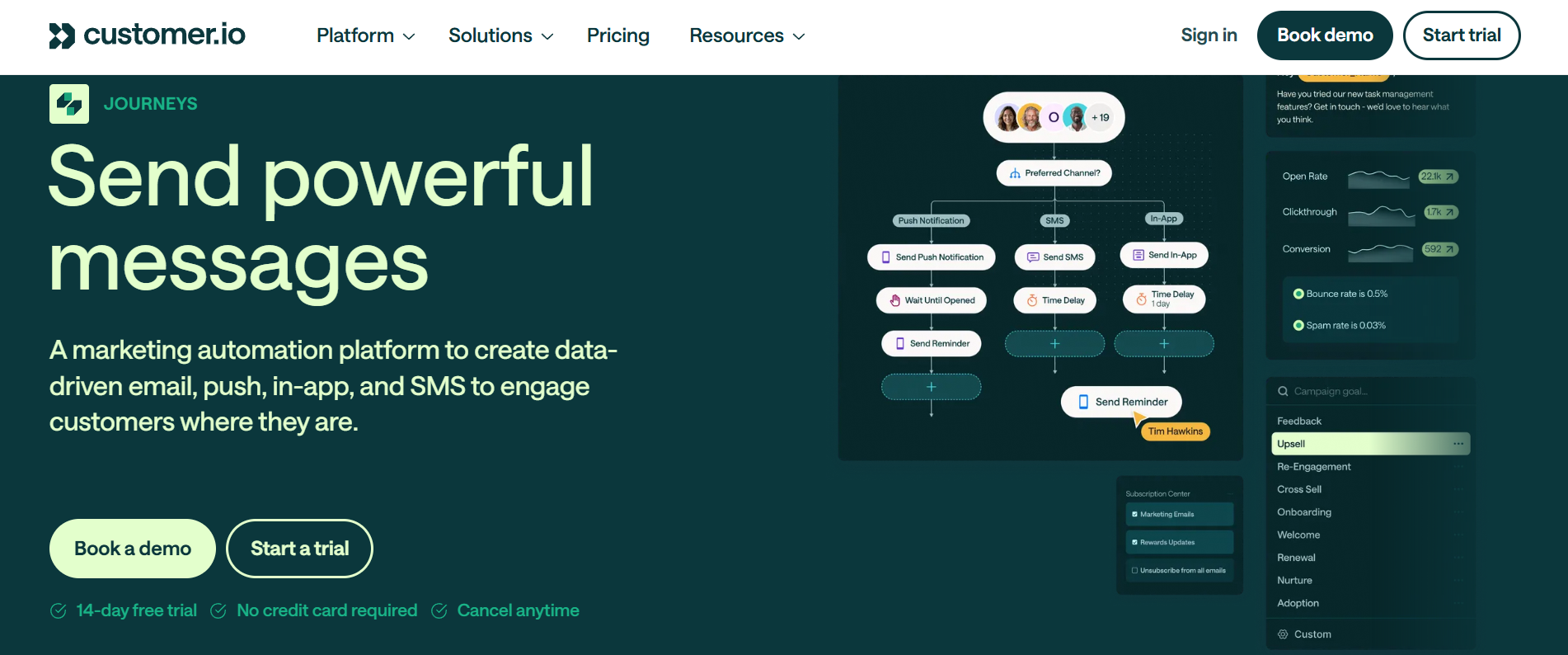
Customer.io supports event-driven marketing orchestration for data-rich environments where customer actions happen in real time. The platform reacts to user behaviour and product events rather than relying on static lists or scheduled campaigns. This makes it suitable for product-led businesses, SaaS platforms, and technical teams that manage complex user journeys. Customer.io is often used where marketing needs to align closely with product usage and lifecycle milestones.
The platform focuses on coordinating engagement decisions based on events such as sign-ups, feature usage, or inactivity. Instead of executing isolated messages, it helps teams guide users through adaptive journeys that respond to how customers interact with a product over time.
Pricing plans
Customer.io pricing scales with the number of customer profiles and messaging volume. Entry plans support smaller datasets, while premium tiers suit larger organisations.
| Plan | Price (USD/month) | Included features | Limitations |
| Essentials | From 100 | 5k profiles, workflows, integrations | Limited object types |
| Premium | From 1,000 | Higher scale, advanced controls | Annual billing required |
7. Ortto

Ortto combines customer data management with AI-assisted lifecycle orchestration to help businesses coordinate engagement across channels. The platform unifies contact data into a single view, allowing teams to manage journeys based on behaviour, attributes, and lifecycle stage. This structure supports consistent decision-making across marketing activities without relying on disconnected tools.
Ortto suits growing businesses that need visibility across the entire customer lifecycle. Its orchestration approach helps teams plan, trigger, and measure engagement in a coordinated way, rather than managing campaigns in isolation. The platform places strong emphasis on lifecycle clarity and cross-channel consistency.
Pricing plans
Ortto offers transparent pricing tiers aligned with contact volume and feature depth. Plans scale from SMEs to enterprise deployments.
| Plan | Price (USD/month) | Included features | Limitations |
| Starter | 169 | Journeys, email, SMS, reporting | Limited advanced channels |
| Professional | 509 | Advanced segmentation, landing pages | Deliverability tools limited |
| Business | 849 | Push, transactional messaging, optimisation | Higher governance needs Enterprise |
| Enterprise | Custom | Dedicated support and advanced control | Quote required |
How Businesses Should Choose an AI Marketing Automation Tool
Businesses should assess AI marketing automation tools based on marketing complexity, data readiness, and governance needs. These platforms influence decisions across the funnel, so suitability depends on how teams manage customer journeys and performance measurement.
Key factors to consider include:
- Funnel structure and lifecycle depth
- Data quality and integration needs
- Channel mix and engagement volume
- Team size and operational control
- Measurement and accountability requirements
A clear evaluation prevents misalignment between tools and business goals.
AI Marketing Automation Tools by System Role
| Tool | Primary role | Best suited for |
| ActiveCampaign | Lifecycle orchestration | SMEs managing ongoing engagement |
| Salesforce Einstein | Predictive intelligence | Enterprise marketing ecosystems |
| Marketo Engage | B2B funnel orchestration | Long sales cycles |
| Braze | Real-time decisioning | Event-driven engagement |
| Omnisend | E-commerce orchestration | Transaction-focused marketing |
| Customer.io | Event-based logic | Product-led growth |
| Ortto | CDP-led orchestration | Unified lifecycle management |
Conclusion
AI marketing automation tools play a central role in coordinating marketing decisions across channels, data, and customer journeys. Rather than focusing on isolated campaigns or individual tasks, these platforms help businesses manage engagement as a connected system. By using behavioural signals and predictive insights, they reduce reliance on manual prioritisation while improving consistency and relevance at scale.
As marketing operations grow more complex, the ability to guide timing, channel selection, and lifecycle progression becomes increasingly important. Understanding how these platforms function as orchestration systems allows business leaders to evaluate tools based on long-term fit, data readiness, and governance needs. When selected thoughtfully, AI marketing automation tools support sustainable growth and operational clarity in 2026 and beyond.