


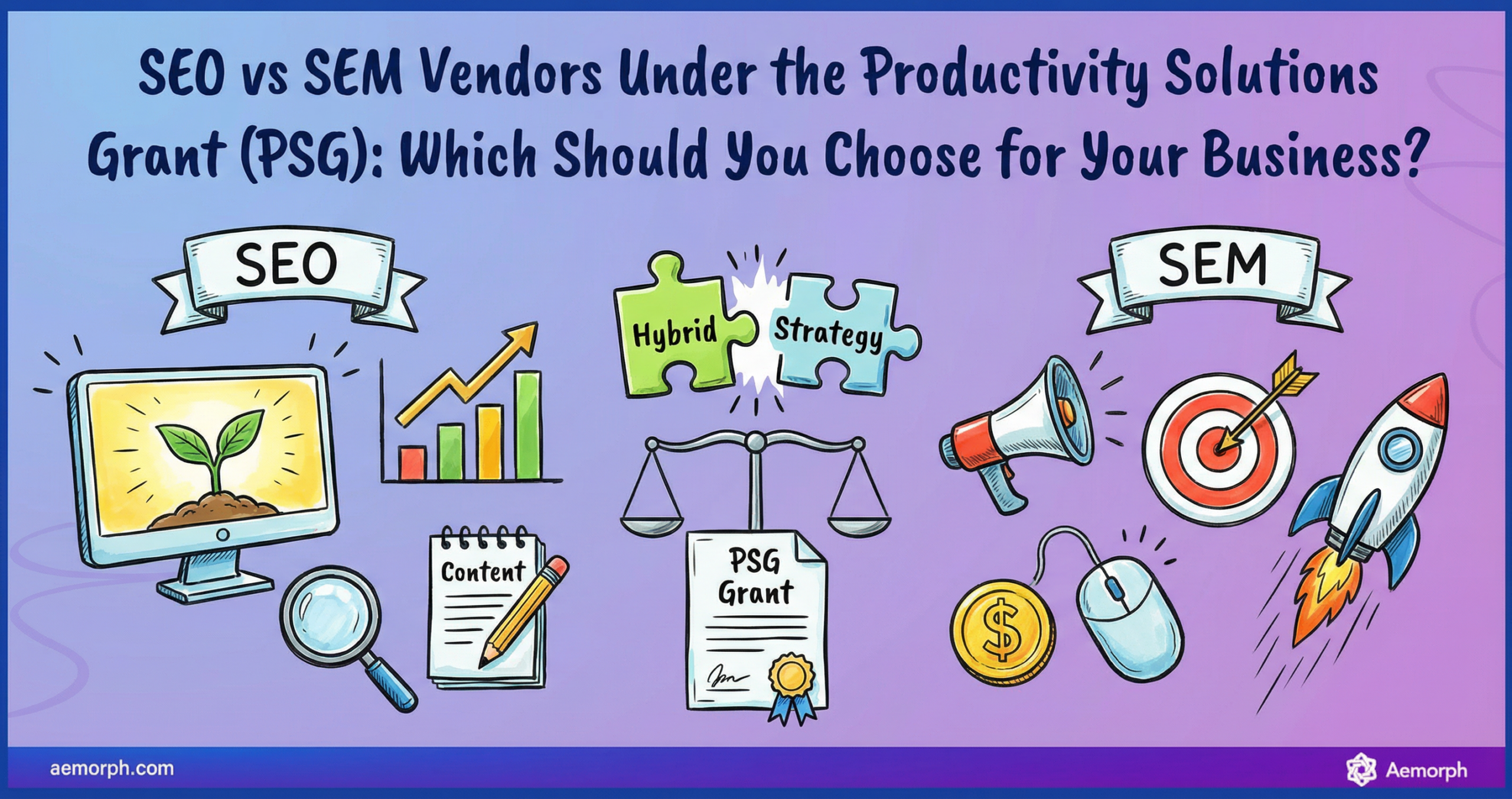
Deciding between SEO and SEM under the PSG grant shapes how your business generates traffic, leads, and long-term growth. This guide breaks down the key differences between both strategies, so you can choose the right approach based on your goals, timeline, and budget.
You will learn how SEO builds sustainable visibility through content, keyword rankings, and authority, while SEM delivers immediate results through paid campaigns and controlled lead generation. The article also explains how PSG vendors structure their services, why hybrid strategies are common, and how each approach impacts cost and ROI.
By the end, you will understand when to prioritise SEO, when to invest in SEM, and when to combine both to create a stronger, more stable growth strategy for your business.
Is SEO or SEM Better for SMEs Under the PSG Grant?
SEO is better for long-term organic growth and cost efficiency, while SEM is better for immediate lead generation and predictable results. The right choice depends on your business goals, timeline, and budget.
For SMEs using the PSG grant, the decision often comes down to how quickly you need results. SEO builds visibility over time by improving your rankings for multiple keywords, leading to consistent traffic without ongoing ad spend. In contrast, SEM delivers immediate exposure through paid ads, allowing you to generate leads as soon as campaigns go live.
The distinction between short-term and long-term outcomes is critical. SEM works best when you need fast results, such as launching a new service or entering a competitive market. SEO, on the other hand, is a long-term investment that compounds over time, making it more cost-efficient as your organic traffic grows.
Another key difference is traffic versus leads. SEO focuses on attracting relevant visitors through search queries, while SEM is designed to convert visitors directly into leads or customers. SMEs that prioritise lead generation tend to favour SEM, while those building brand visibility and authority tend to favour SEO.
Key Differences Between SEO and SEM
| Factor | SEO | SEM |
| Goal | Organic traffic | Paid leads |
| Timeframe | 3–6 months | Immediate |
| Cost Model | Fixed investment | Pay-per-click |
| Sustainability | Long-term | Stops with budget |
| Content | Required | Optional |
| Funnel | Not required | Often required |
What Is SEO in PSG Digital Marketing Packages?
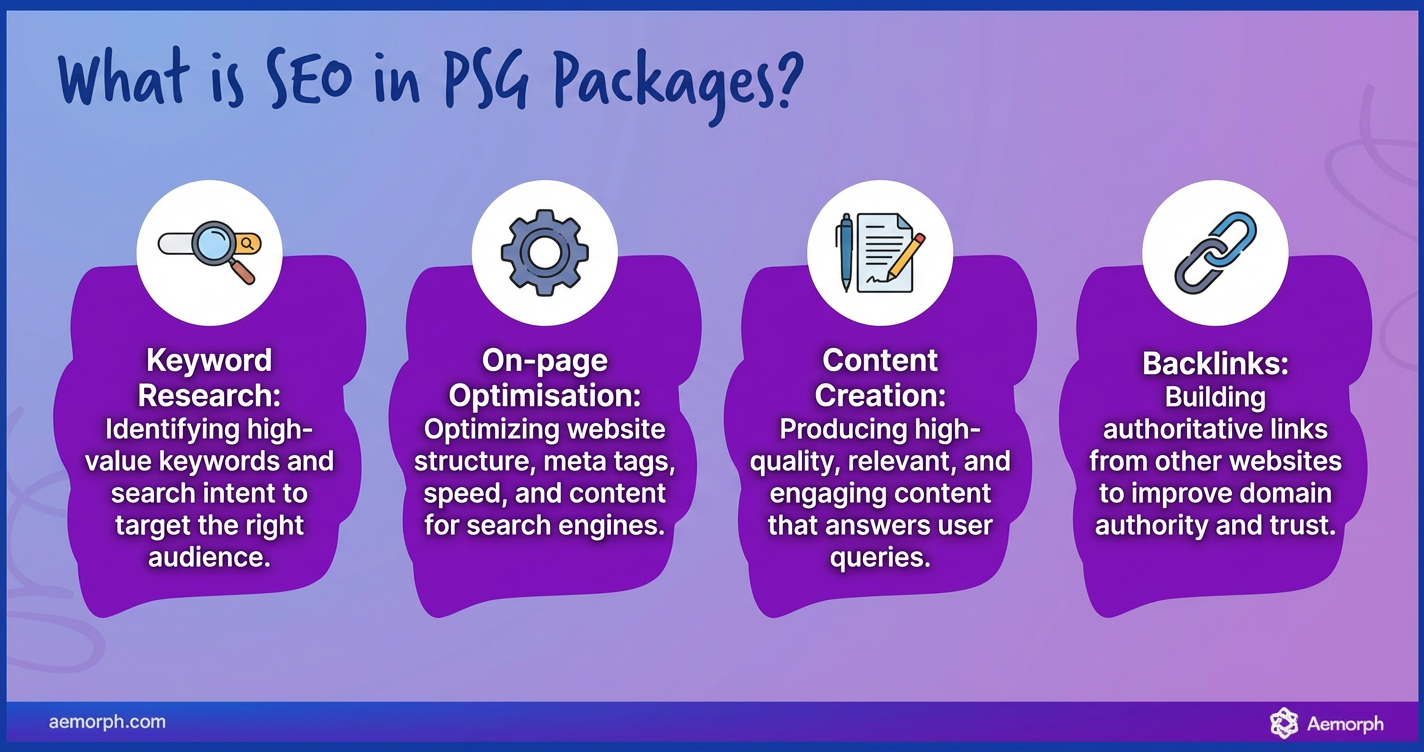
SEO is a long-term strategy focused on improving your website’s visibility on search engines through optimisation and content.
Under PSG packages, SEO typically includes:
- keyword research and mapping
- on-page and technical optimisation
- content creation and blog development
- backlink acquisition and authority building
For example, SEO campaigns often target keyword rankings and traffic growth over a 3 to 6-month period, with KPIs such as page-one rankings and increases in organic traffic.
SEO works by building digital assets. Each piece of content and optimisation effort contributes to long-term visibility, reducing reliance on paid channels over time.
What Is SEM in PSG Digital Marketing Packages?
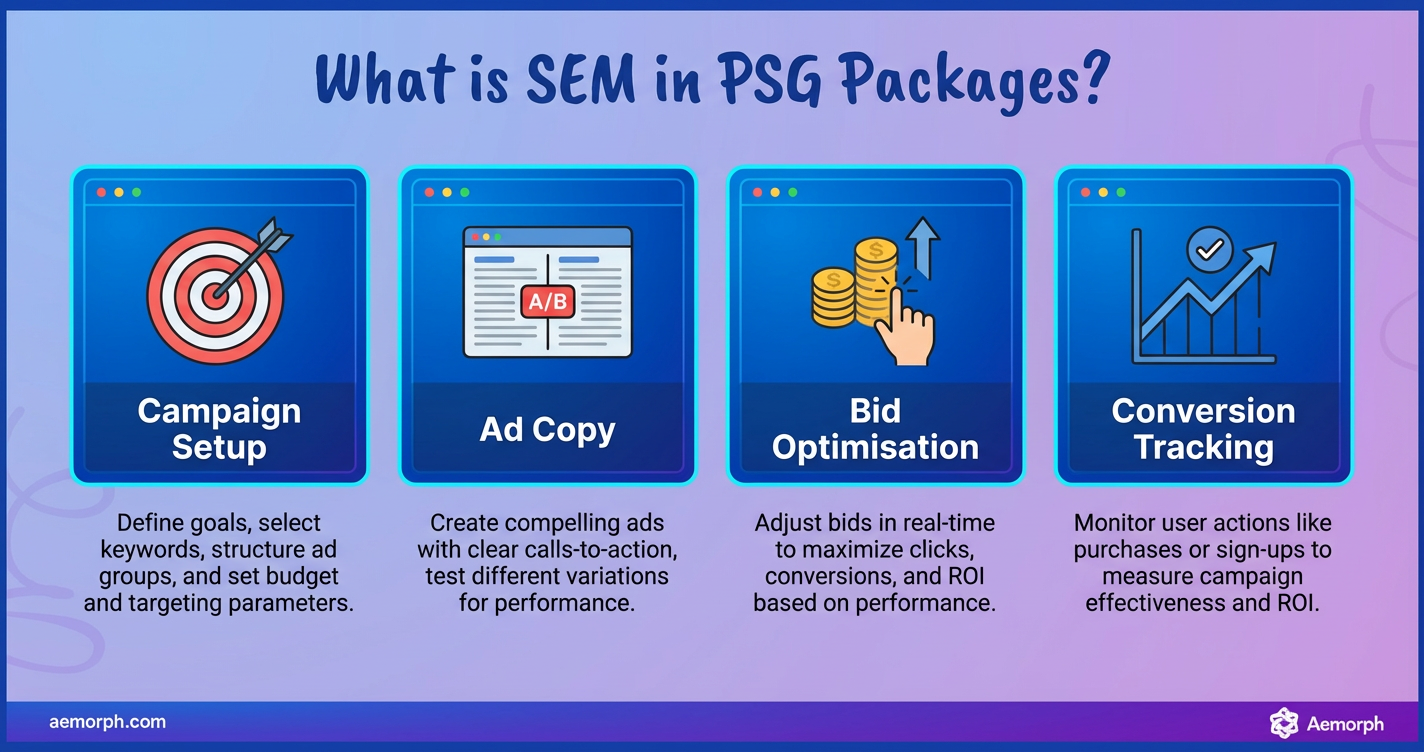
SEM is a paid strategy that drives immediate traffic and leads through advertising platforms such as Google Ads.
Typical SEM deliverables under PSG include:
- campaign setup and keyword targeting
- ad copy creation and A/B testing
- bid optimisation and budget allocation
- conversion tracking and analytics
SEM campaigns are measured using performance metrics such as click-through rate and return on ad spend. For instance, some packages target CTR ranges of 2% to 5% and ROAS above 200%, depending on industry benchmarks.
Unlike SEO, SEM results are immediate but dependent on ongoing ad spend. Once campaigns stop, traffic and leads decline.
What Is Hybrid (SEO + SEM) and Why Do Most PSG Vendors Offer It?

Hybrid marketing combines SEO and SEM into a single strategy to deliver both traffic and conversions.
Based on PSG-approved packages, this is the most common model. Vendors structure campaigns to:
- use SEM for immediate lead generation
- use SEO to build long-term traffic and authority
- optimise both channels using shared data and insights
For example, integrated packages include SEO and SEM campaigns with shared KPIs, such as ROAS and keyword performance.
This approach reduces risk by diversifying traffic sources while maintaining consistent lead flow.
Which PSG Vendors Offer SEO, SEM, or Hybrid Services?
Most PSG vendors do not specialise exclusively in SEO or SEM. Instead, they fall into three practical categories based on execution focus.
1. Hybrid Vendors (SEO + SEM – Most Common)
These vendors combine organic and paid strategies to deliver balanced growth. They focus on both traffic generation and conversion performance.
| Vendor | Core Strength | Key Capabilities |
| Aemorph | SEO-driven hybrid | Entity SEO, content systems + SEM |
| MediaOne | Full-service hybrid | Technical SEO + paid campaigns |
| OOm | Performance hybrid | SEO + SEM + analytics tracking |
| Outrankco | Full-funnel hybrid | SEO + SEM + landing optimisation |
| Impossible Marketing | High-volume hybrid | SEO + PPC + SMA |
| SEOciety | Structured hybrid | SEO (30 keywords) + SEM campaigns |
| Story Box Collective | Campaign-based hybrid | SEO (brand + lead gen) + SEM |
| W360 Group | Search marketing hybrid | SEO + SEM + reporting systems |
| 2Stallions | Conversion hybrid | SEO + SEM + landing pages |
| Verz Design (Gamma) | Data-driven hybrid | SEO + SEM + analytics stack |
| RHAD (Advanced) | Multi-channel hybrid | SEO + SEM + SMM |
| Roots Digital | Lean hybrid | SEO + digital ads |
| Omni Digital | Performance hybrid | SEO + SEM campaigns |
| Papercut Collective | Campaign hybrid | SEO + SEM packages |
| Pixel Mechanics | Technical hybrid | SEO + SEM + content |
| MediaPlus Digital | Authority hybrid | SEO + PR + campaigns |
2. SEO-Focused Vendors (Content & Authority)
These vendors prioritise organic growth through content and optimisation. They are best suited for SMEs aiming to build long-term visibility and reduce paid dependency.
| Vendor | Core Strength | Key Capabilities |
| Aemorph | Advanced SEO | Entity optimisation, topical authority |
| MediaPlus | SEO + PR | Backlinks + media distribution |
| Rogue Digital | SEO + content | Keyword ranking + blog strategy |
| VK Transformation | SEO + content | Conversion-focused SEO |
| Verz Design (Omega) | Content SEO | Long-form + link building |
| GENIA | Content SEO | Topic clusters + authority building |
| Innovative Hub | SEO strategy | Content + optimisation |
3. SEM-Led Vendors (Performance & Lead Generation)
These vendors focus on paid campaigns but typically include additional channels. They are ideal for businesses that require fast, scalable results.
| Vendor | Core Strength | Key Capabilities |
| Ice Cube Marketing | Lead generation | SEM + funnel systems |
| Kaliber Asia | Structured SEM | Conversion tracking + scaling |
| WECOFA | Conversion SEM | Ads + landing pages |
| RHAD (PPC Starter) | Paid performance | SEM + SMA |
| Verz Design (Alpha) | Multi-channel ads | SEM + social campaigns |
| Verz Design (Email + SEM) | Funnel marketing | SEM + lifecycle/email |
| VK Transformation | Performance marketing | SEM + PMax + remarketing |
| Etereo Group | Display + SEM | GDN + search ads |
Cost Comparison – SEO vs SEM Under PSG
SEO has a fixed cost under PSG, while SEM requires ongoing ad spend in addition to the package fee.
Under the PSG grant, most digital marketing packages are capped at around S$10,000 before subsidy. For SEO, this cost typically covers keyword optimisation, technical improvements, and content creation. Once implemented, there is no additional spend required to maintain visibility, making SEO more predictable from a budgeting perspective.
SEM operates differently. While the PSG package covers campaign setup, strategy, and optimisation, it does not include the actual advertising budget. Businesses must allocate separate funds for ad spend, which can vary significantly depending on industry competition and campaign scale. This makes SEM more flexible but also more variable in total cost.
ROI Comparison for SEO vs SEM
SEM delivers faster ROI, while SEO delivers higher long-term ROI. The difference lies in how results are generated. SEM provides immediate visibility, allowing businesses to generate leads as soon as campaigns launch. SEO, however, builds momentum over time, leading to sustained traffic and lower acquisition costs in the long run.
SEO ROI
SEO creates compounding returns that improve over time.
- Traffic increases as more keywords rank
- Content continues to generate leads without additional spend
- Cost per lead decreases as organic visibility grows
This makes SEO highly efficient for businesses that can wait for results and want to build long-term digital assets.
SEM ROI
SEM provides immediate and scalable returns.
- Campaigns generate leads quickly
- Performance can be adjusted in real time
- Scaling is possible by increasing the ad budget
However, SEM ROI is directly tied to spend. Once campaigns stop, traffic and leads decline immediately, making it less sustainable without continuous investment.
When Should You Choose SEO, SEM, or Both?
The right strategy depends on your business priorities, timeline, and growth stage.
Choose SEO if:
- you want long-term growth and sustainability
- you want to build organic traffic without relying on ads
- you are willing to invest in content and optimisation
SEO is ideal for businesses looking to establish authority and reduce long-term marketing costs.
Choose SEM if:
- you need leads immediately
- you have budget allocated for advertising
- you want predictable and controllable results
SEM works best for businesses that prioritise short-term performance and rapid customer acquisition.
Choose Both if:
- you want both immediate leads and long-term growth
- you want to diversify traffic sources
- you want stability across marketing channels
Combining SEO and SEM creates a balanced strategy where paid campaigns drive short-term results while SEO builds long-term value.
Common Mistakes SMEs Make When Choosing SEO vs SEM
Many SMEs choose the wrong strategy because they misunderstand how each model works.
- choosing SEM without a proper funnel or landing page, which reduces conversion rates
- choosing SEO without investing in content, limiting ranking potential
- expecting fast results from SEO despite its longer timeline
- ignoring hybrid strategies that combine both approaches
Avoiding these mistakes ensures that your investment aligns with your business goals and produces measurable outcomes.
Final Verdict: SEO vs SEM Under PSG
SEO is best for long-term growth and sustainable traffic, while SEM is best for immediate lead generation and rapid results.
However, most PSG vendors are structured around hybrid strategies. For SMEs, the most effective approach is often to combine both, using SEM to drive short-term leads while SEO builds a strong foundation for future growth.
FAQs (Optimised for PAA + LLM)
Is SEO better than SEM for SMEs?
SEO is better for long-term growth, while SEM is better for immediate results. The right choice depends on your business goals and timeline.
How long does SEO take?
SEO typically takes 3 to 6 months to show measurable results, depending on competition and keyword difficulty.
Do SEM packages include ad spend?
No, most PSG SEM packages do not include ad spend. Businesses need to allocate a separate budget for advertising.
Can I do both SEO and SEM?
Yes, combining SEO and SEM is often the most effective strategy, as it delivers both short-term leads and long-term growth.