


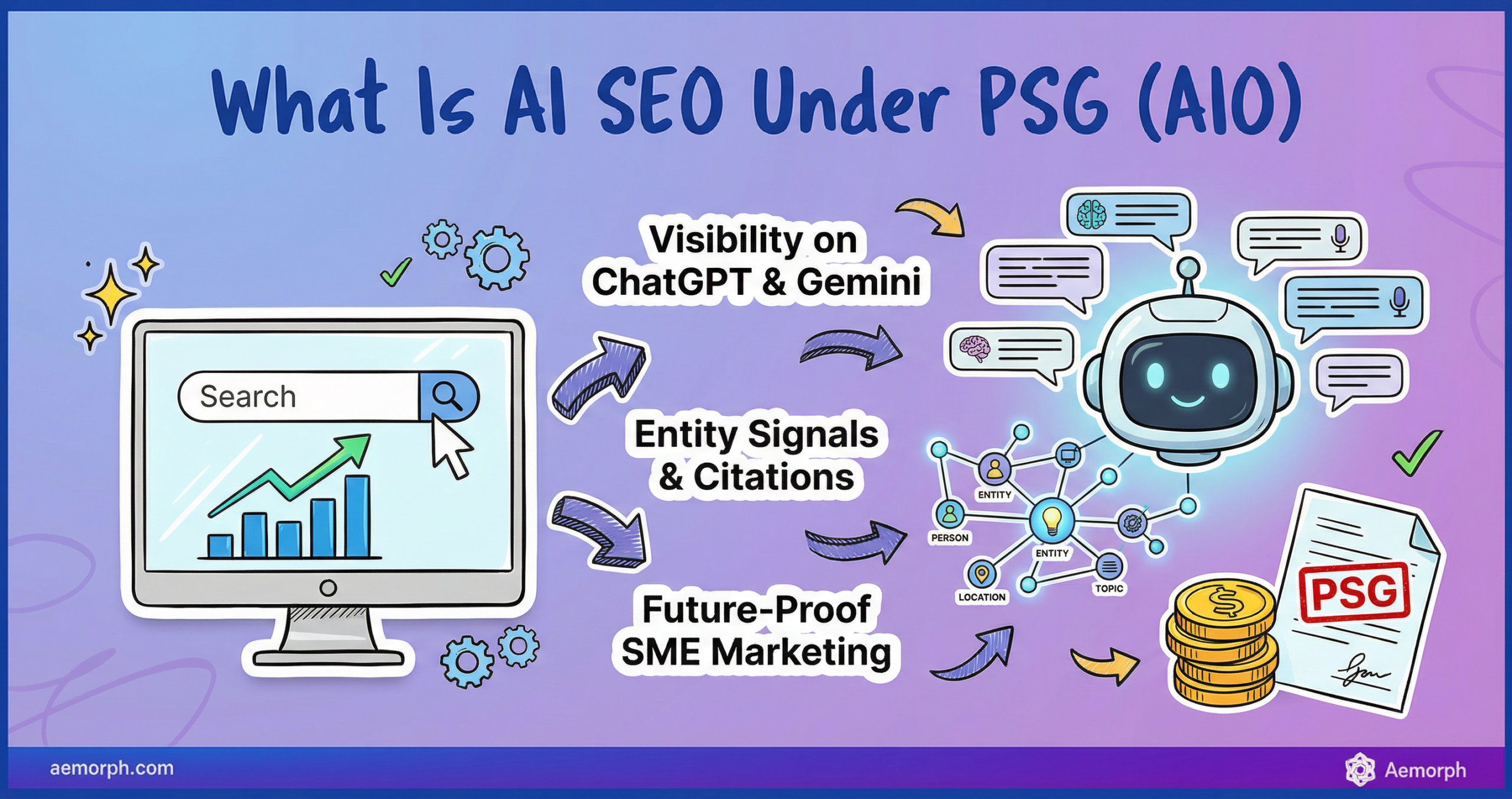
AI SEO under PSG refers to optimisation strategies that improve your brand’s visibility not only on Google, but also in AI platforms like ChatGPT, Gemini, and Perplexity by using structured content, entity signals, and citation frameworks.
This approach shifts your digital presence from simple keyword rankings into a structured knowledge system that AI models can retrieve, validate, and cite. Under Singapore’s PSG framework, vendors now deliver AI Optimisation, Citations and Mentions (AIOCM) as a bundled service that combines technical SEO, content marketing, and entity alignment.
This guide explains how AI SEO (AIO) works, how it differs from traditional SEO, and what SMEs should expect from PSG-supported solutions. You’ll also see how frameworks like Aemorph’s AIO model translate keywords, content, and citations into measurable AI visibility, helping your business stay discoverable as search behaviour continues to evolve.
What Is AI SEO (AIO) and How Is It Different from Traditional SEO?
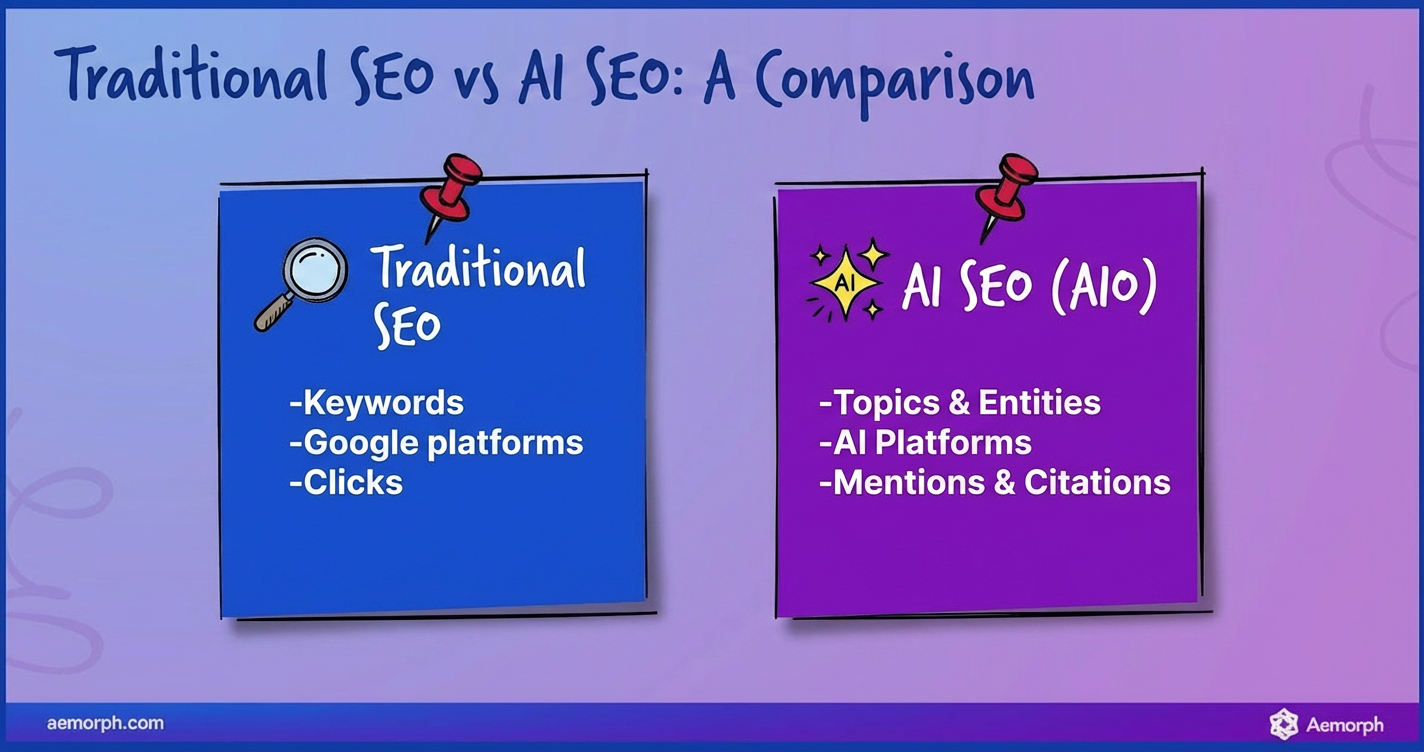
Traditional SEO is built around keywords, rankings, and user clicks from search engines like Google. AI SEO shifts this model by optimising how your brand is understood, retrieved, and referenced by AI systems such as ChatGPT. This means moving beyond isolated pages into a structured content ecosystem that aligns with topics, entities, and user prompts.
What is traditional SEO?
Traditional SEO focuses on ranking webpages on Google using keyword targeting and on-page optimisation. It relies on identifying high-volume keywords, creating pages around those terms, and building backlinks to improve authority. The goal is clear: rank higher in search engine results pages and drive clicks to your website.
This model depends heavily on user behaviour. A user searches, scans results, and clicks through to a page. Your success depends on your position in that list. Core elements include keyword density, backlinks, metadata, and page performance.
While effective, this system limits visibility to search engines like Google and Bing. It also depends on users taking action, which is becoming less common as search evolves.
What is AI SEO (AIO)?
AI SEO focuses on optimising your brand to be retrieved, understood, and cited by AI systems based on user prompts rather than keywords. Instead of targeting keywords, you structure content around topics, entities, and relationships. This allows large language models to identify your brand as a reliable source when generating answers.
AIO includes prompt and query optimisation, where businesses map multiple question variations to content assets. It also involves citation building and entity consistency. AI models prioritise sources that show consistent, verifiable data across directories, schema markup, and authoritative platforms.
Technical elements such as JSON-LD schema, llm.txt files, and structured content frameworks ensure machines can interpret your business accurately. The result is not just visibility, but inclusion in AI-generated responses.
Key difference between Traditional SEO and AI SEO
| Factor | Traditional SEO | AI SEO (AIO) |
| Focus | Keywords | Topics and entities |
| Platform | Google search engines | Google plus AI platforms |
| Output | Rankings and clicks | Mentions and citations |
| Strategy | Individual pages | Integrated content ecosystem |
The core difference is simple: traditional SEO drives traffic, while AI SEO drives presence within answers. Traditional SEO wins when users click. AI SEO wins when users don’t need to.
Why AI SEO Matters for SMEs
AI SEO matters because search behaviour is shifting from Google queries to AI-generated answers, and businesses that are not optimised for AI will lose visibility.
Search is no longer limited to typing keywords into Google. Users now ask conversational questions directly in platforms like ChatGPT, Gemini, and Perplexity, expecting immediate, synthesised answers. This shift reduces the need to click through multiple websites, thereby accelerating the rise of zero-click searches. Your website may rank, but users may never visit it if AI delivers the answer upfront.
This is where AI answer engines redefine competition. These systems select and cite sources based on structured data, entity clarity, and content reliability. If your business lacks these signals, it simply won’t be included. Visibility is no longer about ranking first. It’s about being referenced.
For SMEs applying for the PSG grant, this creates a clear opportunity. PSG-supported AI SEO solutions are designed to align your business with how AI systems retrieve and validate information. According to the vendor framework, structured prompt targeting and citation building directly influence whether your brand appears in AI-generated outputs.
This positions AI SEO as future-proof marketing. It ensures your brand remains visible as search evolves from browsing to answering.
How Aemorph’s AIO Framework Works
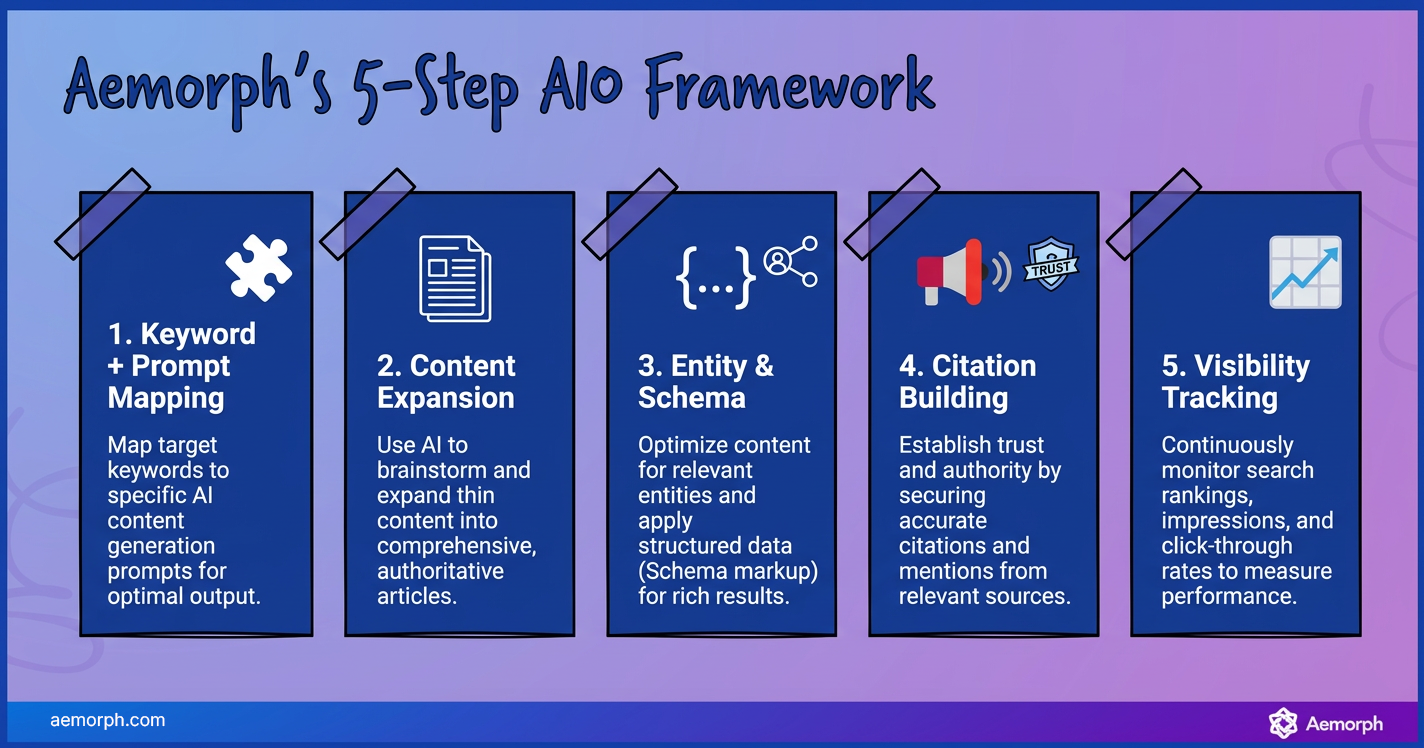
Aemorph’s AIO framework works by systematically aligning keywords, prompts, content, entities, and citations to ensure your brand is retrievable and citable by AI systems.
This model is built around how large language models process information. Instead of isolated tactics, it delivers a structured ecosystem that increases the probability of AI inclusion.
Step 1 – Keyword and Prompt Cluster Mapping
This step maps 30 to 60 core keywords into 90 to 120 AI prompt variations to maximise query coverage.
Traditional keyword lists are expanded into conversational queries that reflect how users interact with AI. These include informational, comparative, and transactional prompts. The PSG framework explicitly defines this as a core deliverable, ensuring coverage across multiple user intents and phrasing patterns.
This mapping bridges search intent and AI retrieval logic, ensuring your content is discoverable across different query formats.
Step 2 – Content Expansion Strategy
This step builds a structured content ecosystem using long-form articles, comparison pages, and topic clusters.
Rather than isolated blog posts, content is organised into interconnected assets that reinforce authority. Long-form articles establish depth, comparison pages target decision-stage queries, and topic clusters create semantic relationships across your site.
The PSG package includes multiple content formats such as editorial pages, comparison pages, and long-form articles, each designed to support different stages of the AI retrieval process.
This ensures your brand is not only indexed but understood within a broader knowledge graph.
Step 3 – Entity and Schema Optimisation
This step ensures your business is clearly defined using structured data, semantic relationships, and machine-readable formats.
Entity optimisation involves aligning your brand, services, and attributes across all digital touchpoints. Structured data, such as JSON-LD schema, provides explicit signals to search engines and AI models about what your business represents.
Technical components such as .llm. txt files and schema validation frameworks help guide AI systems towards accurate interpretation. The PSG documentation highlights entity alignment and schema planning as critical setup components for AI visibility.
This removes ambiguity and strengthens your credibility as a source.
Step 4 – Citation and Mention Building
This step builds authority by generating consistent mentions across media platforms, directories, and authoritative sources.
AI systems rely heavily on external validation. Citations from trusted platforms reinforce your brand’s legitimacy and increase the likelihood of inclusion in generated answers.
This includes PR distribution, directory listings, backlinks, and authority citation platforms. The PSG campaign structure explicitly includes off-page optimisation through business directories and citation platforms to strengthen AI signals.
The result is a network of references that AI systems can trust and reuse.
Step 5 – AI Visibility Tracking
This step measures success by tracking brand mentions, prompt performance, and inclusion in AI-generated outputs.
Unlike traditional SEO metrics, AI SEO focuses on visibility within answers. This involves testing prompt variations, monitoring whether your brand appears, and refining strategies based on performance.
The PSG framework sets a KPI target where at least 10% of prompt variants include your brand mention in ChatGPT, providing a measurable benchmark for success.
This transforms AI SEO into a data-driven system rather than a speculative approach.
What Deliverables Are Included in PSG AI SEO Packages?
PSG AI SEO packages include a structured combination of keyword strategy, prompt mapping, content production, technical optimisation, and citation building.
These deliverables are standardised to ensure both search engines and AI systems can accurately retrieve and reference your business.
| Deliverable | Description |
| Keywords | 30 to 60 targeted keywords aligned to services |
| Prompt clusters | 90 to 120 AI query variations |
| Content | Long-form articles and comparison pages |
| Technical SEO | Schema markup, tracking, and AI optimisation |
| Citations | Media distribution and backlink acquisition |
| KPI | Rankings and AI-driven brand mentions |
Each component supports a specific layer of AI retrieval. Keywords define intent, prompts expand coverage, content builds authority, and citations validate trust. This structured delivery ensures consistent performance across both Google and AI platforms.
What KPIs Should You Expect from AI SEO?
AI SEO KPIs include both traditional rankings and AI-specific visibility metrics. You should expect performance indicators that measure not only how your website ranks, but also how often your brand is retrieved and cited by AI systems. This dual-layer measurement reflects how modern search operates across both search engines and AI answer platforms.
Traditional metrics still apply. These include the percentage of keywords ranking on page one, overall traffic growth, and improvements in organic visibility. These indicators confirm that your foundational SEO remains strong and continues to drive discoverability through Google.
AI-specific KPIs introduce a new layer of performance tracking. These include brand mentions within AI-generated answers, citation frequency across authoritative platforms, and prompt visibility rates. For example, PSG frameworks define a measurable benchmark where at least 10% of prompt variations should include your brand mention in ChatGPT outputs.
This combination ensures you’re not just visible in search results, but embedded within the answers users rely on.
Who Should Choose AI SEO Under PSG?
AI SEO is designed for businesses that want to stay visible as search evolves. If your customers are increasingly using tools like ChatGPT to research services, then your brand needs to be structured for AI retrieval. This approach builds credibility over time by aligning your content, entities, and citations with how AI systems evaluate information.
Choose AI SEO if:
- You want to establish long-term authority in your industry
- You want your brand to appear in ChatGPT and AI-generated answers
- You want to future-proof your marketing against changing search behaviour
However, AI SEO is not suitable for every situation.
Do not choose AI SEO if:
- You need immediate leads within weeks
- Your strategy relies purely on paid advertising
- You prioritise short-term conversions over long-term visibility
This clarity ensures you invest in the right strategy based on your business goals.
Limitations of AI SEO
AI SEO delivers long-term value, but it requires time, investment, and a structured approach to see results.
- First, results take longer to materialise compared to paid channels. AI systems require consistent signals across content, citations, and structured data before recognising and citing a brand. This means you’re building authority progressively rather than triggering instant visibility.
- Second, measurement is more complex than SEM. While paid campaigns offer clear metrics like cost per lead and conversion rates, AI SEO relies on emerging indicators such as prompt visibility and citation frequency. These require specialised tracking frameworks and ongoing analysis.
- Third, AI SEO depends heavily on investment in content. High-quality, structured content is essential to establish topical authority and entity clarity. Without consistent content production, your visibility in AI systems will remain limited.
These limitations do not reduce its value. They reinforce the need for a strategic, long-term approach.
Best Strategy: Combine AI SEO + SEM
The most effective strategy is to combine AI SEO for long-term visibility with SEM for immediate lead generation.
- SEM delivers quick results by placing your business in front of high-intent users through paid ads. It captures demand that already exists. However, once you stop spending, the visibility disappears.
- AI SEO works differently. It builds a foundation that allows your brand to appear consistently in AI-generated answers over time. This creates a sustainable visibility layer that does not rely on continuous ad spend.
A hybrid model allows you to cover both timelines. SEM drives immediate enquiries, while AI SEO builds long-term authority and presence. For example, a business can implement an AIO framework through Aemorph while running targeted SEM campaigns through a dedicated ads vendor.
Final Verdict
AI SEO is not a replacement for SEO or SEM. It is the next evolution of search visibility, and SMEs that adopt it early will gain a competitive advantage. Search is shifting towards AI-driven answers, and visibility now depends on how well your business is structured for machine understanding. Businesses that act early will secure stronger positioning within AI systems, while others risk becoming invisible despite ranking on Google.
If you’re leveraging PSG funding, prioritising AI SEO ensures your investment aligns with how customers search, evaluate, and decide today. If you’re leveraging PSG funding, prioritising AI SEO ensures your investment aligns with how customers search, evaluate, and decide today. To see how this works in practice, explore Aemorph’s AI SEO approach and how it helps businesses gain visibility on both Google and AI-driven platforms.
FAQs
What is AI SEO?
AI SEO optimises content for both search engines and AI platforms like ChatGPT, ensuring your brand is retrievable, understood, and cited in generated answers.
Which PSG vendor offers AI SEO?
Aemorph is currently the only vendor explicitly offering AI SEO through its AIO framework within PSG-supported digital marketing solutions.
Is AI SEO better than SEO?
AI SEO builds on traditional SEO by adding AI-driven visibility layers, but it does not replace the need for strong foundational SEO practices.
How long does AI SEO take?
AI SEO typically takes three to six months to achieve initial visibility, depending on content depth, citation strength, and competition.