


Facebook marketing remains one of the most versatile and scalable tools available to small and medium-sized enterprises (SMEs) in 2026. With its cross-platform reach, built-in measurement tools, and support for both organic and paid strategies, it enables smaller teams to grow visibility, engage customers, and drive sales, all within a system increasingly built for transparency and control.
This guide outlines exactly what Facebook marketing encompasses today and breaks down how SMEs can use it to achieve real, measurable outcomes. From improving first-party data strategy to regional content alignment and operational readiness, you’ll learn how to approach Facebook with clarity, structure, and confidence.
What is Facebook Marketing?
Facebook marketing refers to the use of Meta’s platforms Facebook, Instagram, and Messenger to build brand presence, engage audiences, and drive conversions. It includes both organic strategies, like Facebook Pages, Groups, and Reels, and paid advertising through tools such as Meta Ads Manager and Business Suite.
Marketers can use Facebook Shops and Catalogue to support commerce, while features like Events and Messenger enable direct interaction and community-building. Campaigns operate within Meta’s policy framework, which outlines creative standards, ad eligibility, and industry-specific restrictions.
For execution and performance tracking, the platform offers tools including Business Suite, Ads Manager, Pixel, Events Manager, and the Conversions API. These work together to manage campaigns, track events, and measure outcomes across multiple placements.
Understanding this scope is essential for planning budgets, aligning cross-functional teams, and setting realistic goals. When marketers clearly distinguish between organic engagement, paid distribution, and platform policies, they reduce miscommunication and improve governance. Shared terminology around surfaces, tools, and metrics also ensures that performance insights lead to better decisions and more efficient scaling.
Why Facebook Marketing Benefits SMEs in 2026
In 2026, small and medium-sized enterprises (SMEs) continue to prioritise marketing channels that offer reach, transparency, and control. Facebook remains a valuable platform by delivering scalable audience access, reliable performance tracking, and well-defined policy standards. These qualities help lean marketing teams move faster, without being burdened by complex tech stacks or unpredictable ad ecosystems.
The platform’s utility is especially clear across Southeast Asia, Singapore, and Australia, where mobile-first behaviour and short-form video consumption dominate. Facebook’s support for server-side tracking and first-party data further strengthens reporting accuracy, which improves forecasting, budget planning, and cash flow confidence.
1. Audience Reach and Attention at a Useful Scale
Facebook remains a large, mobile-first environment that can produce steady reach for SMEs. Cross-app distribution allows content to find audiences beyond a single feed. Repeated exposures support brand recall across short planning cycles. The net effect is more chances to be seen by the right people in familiar environments.
What makes this valuable:
- Consistent daily usage patterns, especially favouring short-form videos and static image posts
- Cross-platform distribution across Facebook, Instagram, and Messenger
- Familiar user behaviours such as sharing, commenting, and community discussions via Groups
- Mobile-first interface that matches browsing habits in Singapore, Australia, and Southeast Asia
Scale only matters when it is relevant and repeatable. SMEs gain more value when visibility comes through steady engagement rather than volatile spikes. Facebook’s format mix, especially Reels and Stories, also reduces production overhead, allowing smaller teams to deliver fresh, high-performing content without long lead times.
2. Measurable Outcomes and Executive-Level Reporting
Facebook’s ad ecosystem offers clearly defined objectives and standardised metrics, making performance reporting easier for leadership teams and boards. Consistent measurement frameworks reduce ambiguity in reviews and help align stakeholders on progress, pacing, and planning.
Benefits to SMEs:
- Objectives that align with funnel stages: awareness, consideration, and conversion
- Standard metrics like CPM, CPC, CTR, CVR, and ROAS to guide campaign optimisation
- Full account transparency with histories, change logs, and assigned roles
- Naming conventions that support clean reporting and trend tracking over time
Clarity helps boards and finance teams judge progress across quarters. When outcomes are measured consistently each month, decisions improve. Routine visibility also encourages earlier corrections rather than end-of-quarter surprises. For SMEs, that discipline protects limited budgets.
3. First-Party Data Alignment and Signal Resilience
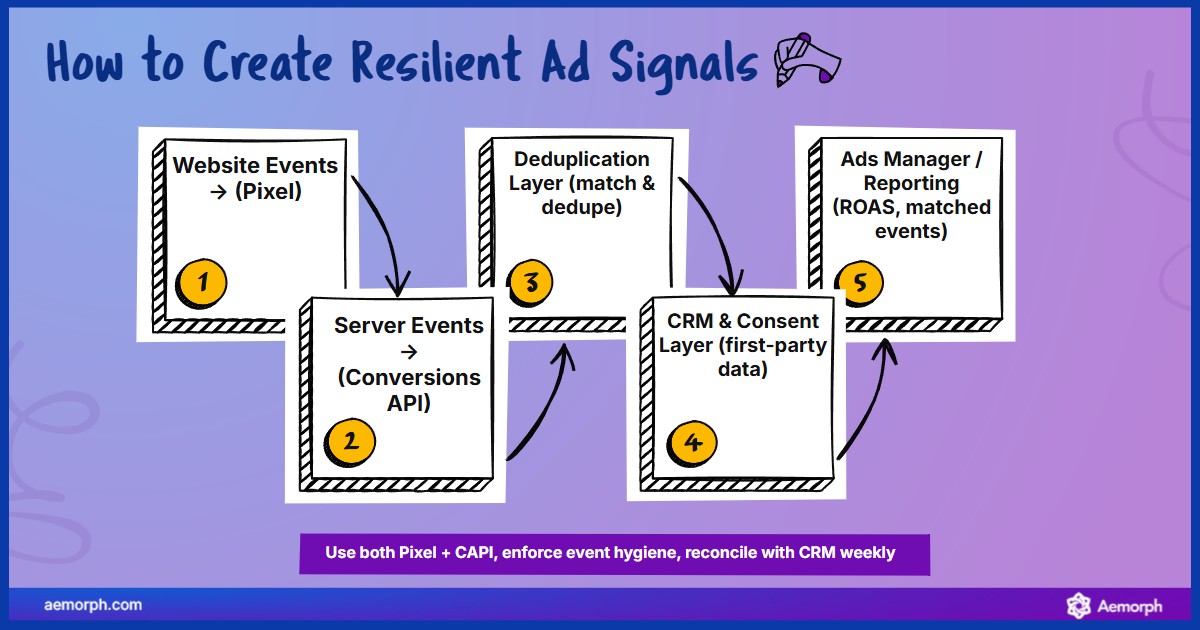
As browser-based signals weaken and privacy standards evolve, Facebook’s server-to-server tracking, via the Conversions API, helps SMEs maintain accurate attribution and campaign efficiency. When used with the Pixel, this setup improves signal quality and strengthens campaign feedback loops.
Technical and operational strengths:
- The Pixel and Conversions APIs are used together with deduplication rules.
- Match rate targets are documented and reviewed regularly.
- Event hygiene that maintains consistency in names, parameters, and consent.
- Dashboards that reconcile advertising data with CRM records.
Stable signals mean better attribution, clearer ROAS, and less wasted spend. For SMEs, this reduces friction between sales and marketing by unifying what counts as success. More reliable data also sharpens forecasting and enables weekly or monthly spend decisions with greater confidence.
4. Region Fit: Singapore, Australia, and Southeast Asia
Mobile-first behaviour and social video consumption are well-documented across SEA. These patterns support short-format communication and quick feedback loops. Local commerce habits also pair with messaging surfaces that reduce friction. Teams can plan with regional evidence rather than generic global averages.
Why it works regionally:
- Social video trends show rising consumption of Reels, Stories, and short-form content
- High mobile usage reinforces the need for responsive, vertical creative.
- Commerce behaviours favour discovery, research, and messaging before purchase.
- Localised scheduling and language targeting ensure cultural and timezone relevance.
SMEs can design content for real usage patterns, avoiding assumptions based on global trends. Regional fit enhances performance predictability, reduces waste, and justifies granular planning across creative, media, and timing.
5. Policy Guardrails that Protect Operations
Facebook’s advertising standards define what’s acceptable, how reviews are conducted, and the steps to resolve flagged content. These guardrails are especially critical for SMEs, where one rejected ad or suspended account can disrupt momentum and revenue.
What SMEs gain:
- Clear definitions of restricted claims and suitability categories, written in accessible language
- Documented processes for ad review, appeals, and escalation
- Change logs and approval records that support audit trails and vendor accountability
By operating within clearly defined boundaries, teams minimise downtime and avoid surprises. When campaigns run uninterrupted through key moments, launches, sales events, or seasonal peaks, businesses gain a competitive edge through consistency and reduced recovery time.
6. Organisational Efficiency Across Teams
Meta’s Business Suite simplifies collaboration across content, community, and paid media. With shared dashboards and role-based access, small teams can maintain visibility and control without siloed workflows.
Efficiency enablers:
- Role-specific permissions for Pages, ad accounts, catalogues, and pixels
- Shared inboxes across Facebook and Instagram for unified messaging
- Centralised scheduling, analytics, and health monitoring in one interface
- Asset naming standards that ensure clarity and ease of collaboration
These features help SMEs stay agile. When processes are streamlined, teams spend less time managing tools and more time focusing on creative, strategy, and performance. The result is sustainable output with fewer handoffs, even at limited headcount.
Readiness Checklist Before Investing in Facebook Marketing
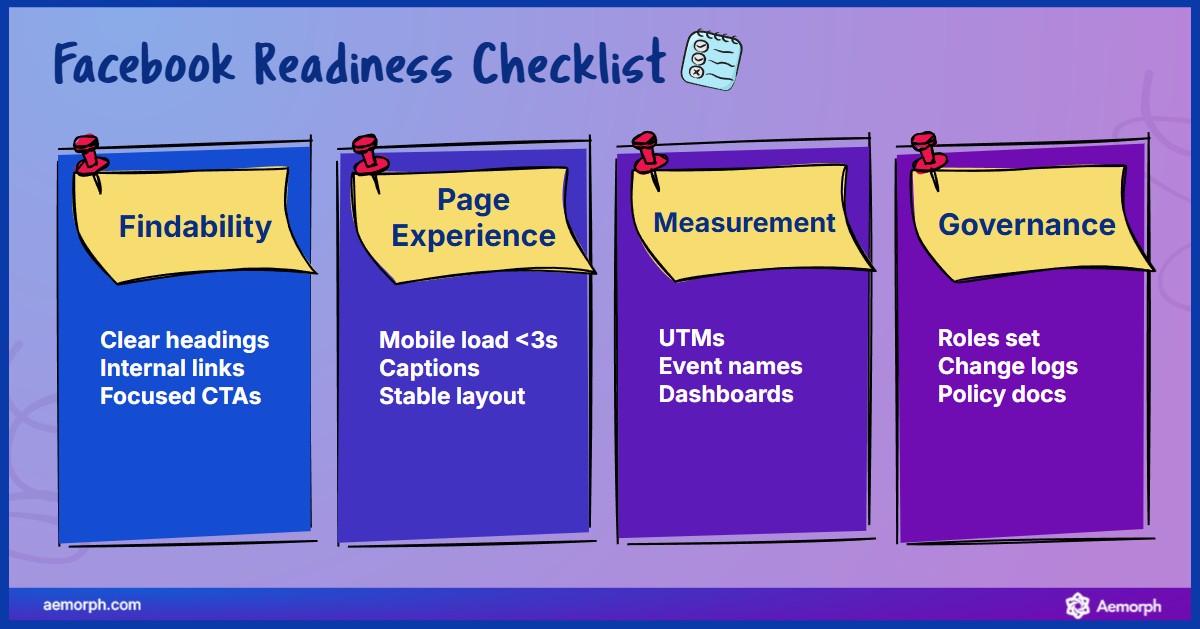
A strong foundation increases the success rate of Facebook campaigns. This checklist ensures visibility, compliance, and data clarity are in place before investing media spend. It also helps reduce avoidable rework, policy flags, or tracking errors.
Focus areas:
- Findability and clarity: Sensible information architecture, helpful internal linking, clear headings, and focused calls to action.
- Page experience: Fast loads on mobile, stable layouts, accessible captions, and consistent design patterns across variants.
- Measurement hygiene: UTM structure, consistent event naming, baseline dashboards, and routine performance reviews
- First-party data: Consent collection aligned to PDPA/GDPR, well-maintained CRM lists, and retention policies
- Signal setup: Pixel and Conversions API configured with deduplication and target match rates
- Policy readiness: Claim checks, documentation for sensitive content, and an internal appeals process
- Creative compliance: Rights-cleared assets, compliant ad copy, and variant-ready campaigns for A/B testing
- Governance: Business Suite access roles, changelogs, and quarterly specs and permissions audits
A clean setup improves the quality of early results and prevents operational friction. It also gives leadership confidence that marketing is being executed responsibly, with tracking and compliance in place. By checking these boxes early, SMEs are better positioned to make data-backed decisions and scale with fewer surprises.
Improve Brand’s Presence Before Facebook Activity
Search visibility influences how people validate brands after first contact. Many visitors turn to search before submitting a form or making a purchase. Improving organic presence raises the value of any future social traffic. It also strengthens site clarity and measurement.
Improving organic visibility not only increases qualified traffic but also enhances clarity, trust, and attribution accuracy. Search optimisation helps your Facebook efforts convert more effectively by providing a credible, high-quality destination.
Key elements to address:
- Technical and structural updates that improve crawlability and index coverage
- Messaging aligned with real buyer language and search intent
- On-page enhancements across titles, descriptions, and internal links
- Analytics and consent setups that ensure accurate, compliant tracking
Aemorph can provide this SEO support for SMEs that want stronger organic visibility and clearer site experiences before using Facebook marketing. Engagements focus on structure, search-led content, and analytics hygiene so paid social benefits from a better baseline.
How Facebook Supports a Broader Social Media Marketing Strategy
While Facebook remains a core platform for SMEs, its effectiveness increases when it is positioned within a broader social media context. Businesses gain more value when Facebook efforts are complemented by activities on Instagram, LinkedIn, TikTok, or Messenger—each serving a distinct role in customer engagement.
As part of a cross-platform marketing approach, Facebook is ideal for retargeting and community building, while short-form content may reach a wider audience on video-first networks. SMEs benefit most when each platform’s role is clearly defined and aligned with campaign stages—from awareness to conversion.
Even if Facebook leads your campaign, the outcome improves when content, CTAs, and measurement are consistent across a multi-platform strategy. For example, insights from Meta Ads Manager can inform creative refinements on Instagram or fuel organic storytelling on LinkedIn.
Ultimately, while many platforms compete for attention in today’s digital landscape, Facebook continues to offer SMEs a unique blend of scale, structure, and control. When used with clarity and readiness supported by a strong SEO foundation and aligned campaign planning, Facebook can complement and accelerate your marketing strategy. For small teams with big ambitions, that clarity is a competitive advantage.