


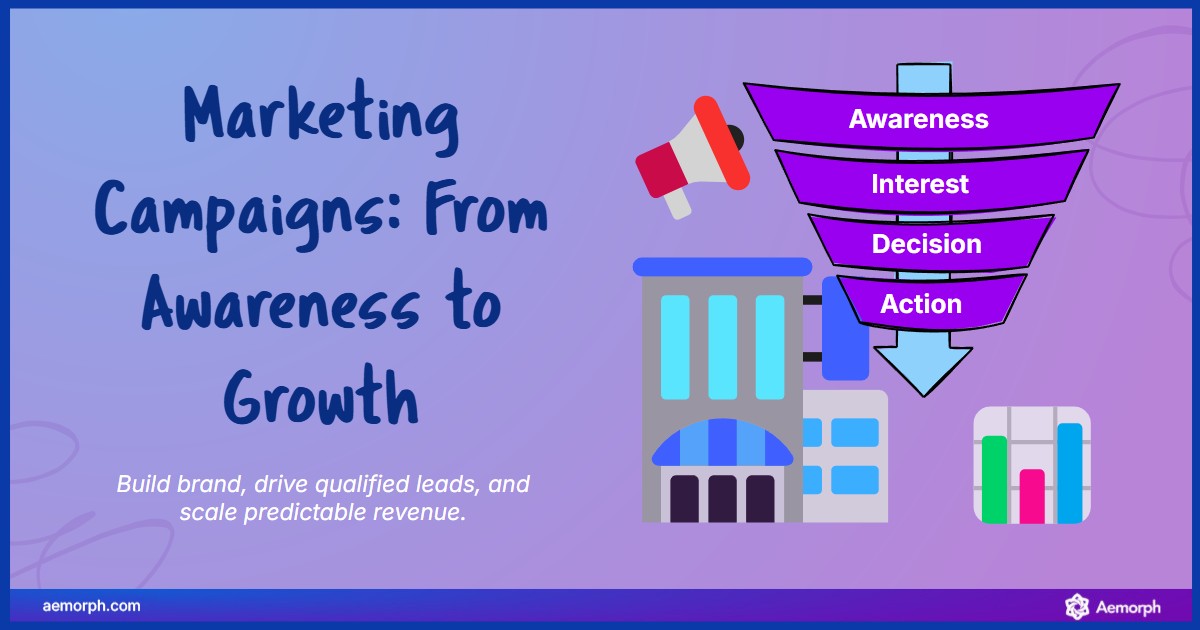
Marketing campaigns are deliberate, structured efforts designed to achieve a clear business goal, from raising awareness to generating revenue. For small and medium-sized enterprises (SMEs), a campaign is not a random set of ads but a system that brings together strategy, creativity, and measurement. Each campaign focuses on a defined objective, audience, and channel mix, ensuring that every marketing pound contributes to tangible outcomes. Understanding how marketing campaigns work and how they benefit your business enables leaders to allocate resources effectively and sustain consistent growth.
What are Marketing Campaigns?
A marketing campaign is a coordinated sequence of actions designed to drive a measurable response from a target audience. It involves defining objectives, selecting communication channels, setting budgets, crafting messages, and tracking performance through data analytics. Unlike one-off promotions, campaigns follow a structured lifecycle of planning, execution, measurement, and optimisation, creating a feedback loop that improves over time.
Evidence from industry practice:
- Successful campaigns begin with a well-defined purpose, such as boosting brand visibility, generating qualified leads, or promoting a new product.
- They integrate multiple channels, including social media, email, paid search, and offline events, ensuring consistent messaging across touchpoints.
- Each campaign is anchored in customer insight, using data and behavioural patterns to guide creative decisions.
- Measuring key performance indicators (KPIs) like conversion rate, cost per acquisition, and ROI ensures marketing activity remains accountable to leadership goals.
By treating campaigns as measurable systems, SMEs can move beyond reactive advertising and build predictable marketing engines that compound returns across each quarter.
Types of Marketing Campaigns for SMEs
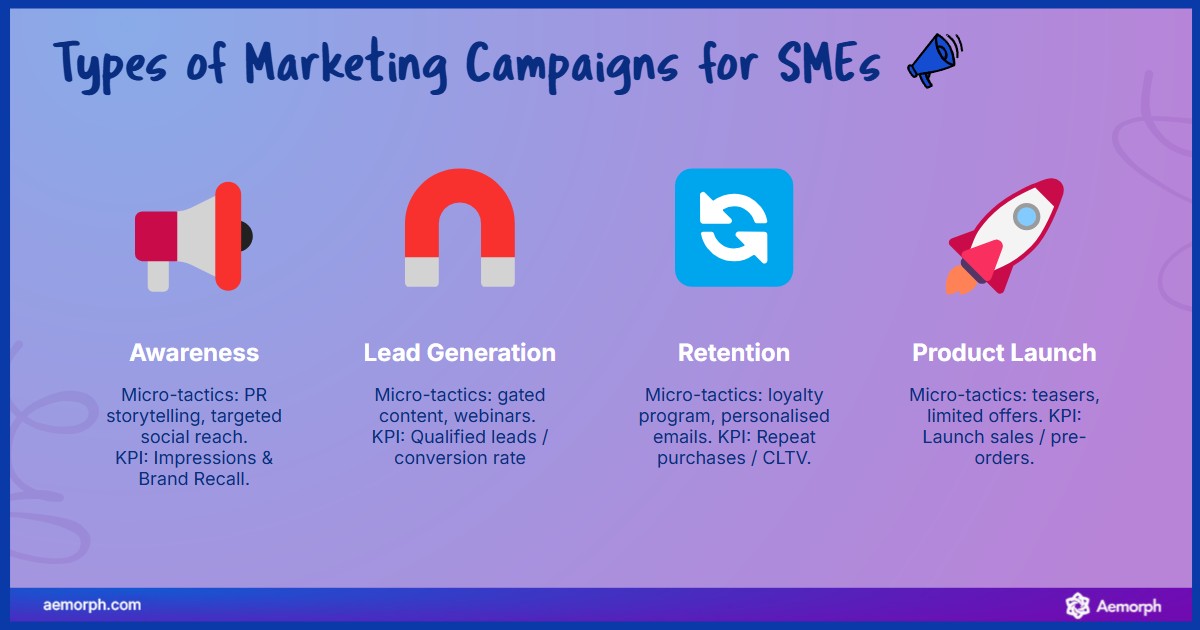
Different campaign types serve distinct purposes depending on where the customer is in the buying journey. SMEs can adapt these frameworks to fit specific growth stages and available budgets.
Practical examples and applications:
- Awareness campaigns introduce a brand to new audiences using storytelling, PR, and targeted media placement.
- Lead generation campaigns capture contact details through gated content, free consultations, or webinars that attract prospects with genuine interest.
- Retention campaigns nurture existing customers through loyalty programmes, newsletters, or personalised offers that encourage repeat purchases.
- Product launch campaigns build anticipation for new products or services through teaser content and limited-time promotions.
- Community or CSR campaigns focus on social contribution to strengthen brand trust and reputation.
Each campaign type fits within a broader marketing strategy. By understanding their purpose and expected outcomes, SMEs can decide which approach delivers the greatest business impact at any given time.
Strengthening Campaign Strategy Through Marketing Fundamentals
Marketing campaigns are only as effective as the strategies that support them. While execution matters, understanding the broader mechanics of positioning, promotion, targeting, and performance measurement gives SMEs the clarity to choose and adapt the right campaign type.
For a deeper look at how these core marketing functions work in practice, explore Aemorph’s marketing insights, covering content, SEO, messaging, and more to help refine your approach.
Why Marketing Campaigns Matter for Your Business
Marketing campaigns translate ambition into measurable growth. For CEOs and marketing managers, they are essential for connecting vision with execution. A well-planned campaign not only communicates value but also builds relationships, collects data, and fuels revenue cycles. The following sections outline the key benefits that make campaigns indispensable to SME success.
1. Builds Brand Awareness and Recognition
Brand awareness is the foundation of all marketing success. A company must first be seen and remembered before it can be trusted or chosen. Marketing campaigns help SMEs achieve this by maintaining visibility across the platforms where their audience spends time. Consistency in messaging, tone, and visual identity turns a brand from an occasional encounter into a familiar presence.
- Repeated exposure increases familiarity. Marketing research consistently shows that brands that appear multiple times across different channels are more likely to be remembered and chosen over alternatives, because familiarity lowers the buyer’s perceived risk.
- Uniform use of brand colours, slogans, and typography reinforces recall and credibility.
- Combining paid and organic efforts, such as social ads and SEO-driven content, accelerates reach while sustaining cost efficiency.
Consistent exposure ensures your brand stays front of mind when purchasing decisions are made. Over time, awareness lowers acquisition costs because customers already recognise and trust your name before engaging with your offer.
2. Drives Qualified Leads and Sales Conversions
A campaign’s ultimate test lies in its ability to convert attention into revenue. Effective marketing campaigns guide potential customers through a structured funnel, from awareness to consideration, and ultimately to purchase. For SMEs with limited budgets, strategic targeting and data-driven creative execution can produce significant returns without overspending.
Examples and insights:
- Targeted ad campaigns combined with email automation can increase lead quality by up to 40 per cent compared to non-segmented approaches, according to HubSpot’s 2024 benchmark report.
- Implementing a clear value proposition and a compelling call to action at every stage of the campaign accelerates conversion.
- Retargeting past website visitors or abandoned carts keeps your business top of mind, turning missed opportunities into sales.
- Campaign data highlights which channels deliver the highest ROI, enabling strategic allocation of future resources.
By focusing on precision rather than volume, SMEs can attract high-intent leads who are more likely to convert. Over time, these data-backed adjustments transform campaigns into reliable revenue pipelines.
3. Improves Customer Retention and Loyalty
Acquiring new customers is often 5x as expensive as retaining existing ones. Retention campaigns strengthen loyalty by maintaining communication, delivering value, and recognising repeat buyers. For SMEs, this creates a stable revenue base that supports growth even during market fluctuations.
Proven Tactics That Strengthen Customer Loyalty:
- McDonald’s “Just For You” campaign used personalisation and app-based offers to deepen engagement, resulting in measurable increases in repeat orders.
- Bain & Company research has shown that loyalty programmes that reward ongoing patronage can boost profitability by 25 to 95 per cent, depending on industry.
- Email newsletters that provide tips, updates, and promotions keep customers engaged beyond the initial sale.
- Automated systems such as HubSpot or Mailchimp help SMEs maintain consistent communication without additional workforce.
Retention marketing not only secures recurring income but also turns satisfied clients into advocates who amplify your brand through referrals, creating a compounding effect that reduces long-term marketing costs.
4. Strengthens Brand Reputation and Trust
Trust is built when businesses communicate transparently and consistently deliver on promises. Marketing campaigns that demonstrate authenticity, social responsibility, and openness enhance public perception. This becomes especially important for SMEs, where reputation often drives competitive advantage.
Evidence from real campaigns:
- The IRVINS’ apology campaign showcased accountability and empathy, transforming public criticism into renewed loyalty and admiration.
- Campaigns built around honest storytelling, customer success stories, or community initiatives demonstrate corporate integrity.
- Maintaining consistent values across platforms signals dependability to both customers and search engines, strengthening E-E-A-T signals.
- Encouraging user reviews and featuring testimonials within campaign assets creates a feedback loop of credibility.
When audiences perceive a business as trustworthy, engagement metrics rise naturally, from higher click-through rates to longer website sessions, turning integrity into a measurable business asset.
5. Supports Data-Driven Decisions and Optimisation
Every marketing campaign produces a wealth of actionable data. Analysing this data empowers businesses to refine targeting, adjust messaging, and optimise budget allocation. Data-driven decision-making ensures that campaigns evolve based on evidence rather than guesswork.
Strategic insights and metrics:
- Marketing dashboards reveal the performance of each channel, identifying which platforms deliver the most engagement or conversions.
- Tracking KPIs such as cost per click (CPC), customer acquisition cost (CAC), and return on ad spend (ROAS) connects marketing outputs directly to financial results.
- A/B testing allows SMEs to compare creative variations, ensuring resources are invested in what performs best.
- Advanced analytics tools like Google Looker Studio or Power BI help visualise campaign trends over time.
With these insights, leaders can pivot quickly, replicate success, and eliminate underperforming tactics. The result is a marketing operation that continuously learns and improves, delivering stronger returns quarter after quarter.
6. Creates Scalable Marketing Systems
A well-executed campaign can serve as a repeatable model for future initiatives. This scalability transforms marketing from an experimental process into a growth framework. By documenting workflows, results, and learnings, SMEs can replicate success across markets, products, or services.
Application in business growth:
- Process templates standardise planning, creative development, and reporting, shortening setup time for future campaigns.
- Automation platforms like Hootsuite and Mailchimp allow teams to manage multiple campaigns simultaneously without losing control.
- Maintaining consistent brand assets ensures uniform identity across geographies or departments.
- Analysing historical campaign data helps forecast outcomes and set realistic performance benchmarks.
Scalable marketing systems free business leaders from daily execution, allowing them to focus on innovation and strategic partnerships. Over time, each campaign adds to an institutional knowledge base that strengthens organisational efficiency.
7. Encourages Cross-Team Alignment
Marketing campaigns bridge the gap between departments by aligning everyone behind shared metrics and timelines. When marketing, sales, and operations work from the same data, accountability and collaboration naturally increase. This alignment is particularly valuable for SMEs, where resources are limited and teamwork determines success.
Collaborative practices that reinforce alignment:
- Shared KPIs such as qualified lead volume or conversion-to-sale ratio create a common language between marketing and sales.
- Joint planning sessions allow leaders to synchronise campaign goals with broader business targets.
- Regular reporting cycles ensure performance updates are transparent across teams.
- Feedback from customer service teams informs content and messaging, closing the loop between front-line insight and strategy.
When campaigns operate as company-wide initiatives rather than isolated marketing efforts, they drive cohesive growth and a unified customer experience.
How to Plan a High-Impact Marketing Campaign
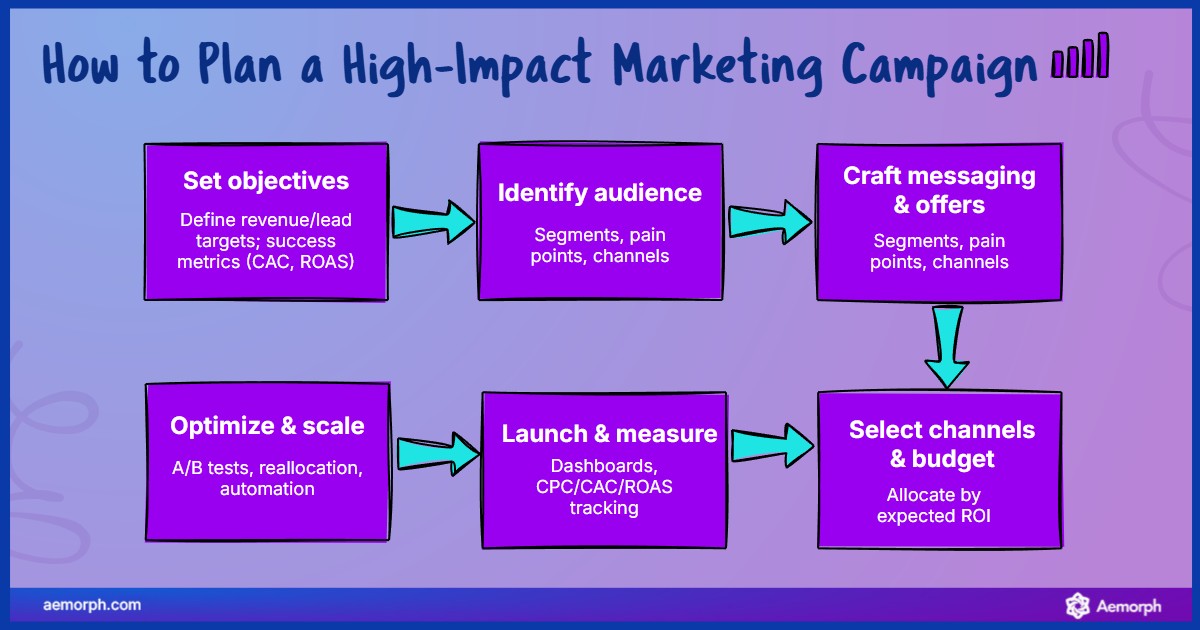
Planning determines whether a campaign succeeds or underperforms. SMEs benefit from a structured approach that connects goals with execution while leaving room for creativity. Each stage builds upon the previous one to create measurable outcomes.
Structured planning approach:
- Set clear objectives aligned with measurable business outcomes such as revenue growth or lead acquisition. Clear goals give your campaign purpose and a benchmark for success. Without defined outcomes, you can’t measure or justify your marketing investment.
- Identify target audiences using demographic, behavioural, and psychographic data. Understanding who you’re speaking to ensures your message resonates. Targeting the right people reduces wasted spend and increases conversion efficiency.
- Craft messaging and creative assets that speak directly to audience needs and motivations. Generic content gets ignored. Tailored messaging builds emotional relevance and drives action, whether that’s a click, a download, or a purchase.
- Select channels and allocate budgets based on expected ROI and customer preferences. Putting your message where your audience already spends time maximises visibility. Budget alignment also prevents over-investing in low-performing platforms.
- Measure and refine by monitoring results in real time and adjusting campaigns to optimise performance. Continuous optimisation prevents wasted effort. Data-backed decisions improve ROI over time and make future campaigns more effective from day one.
Following these steps ensures that every campaign contributes meaningfully to business growth while building a framework for future improvement.
Turning Marketing Campaigns into a Growth Engine
Marketing campaigns are the operational backbone of predictable business growth. For SMEs, a campaign-driven approach brings structure, accountability, and sustainability to marketing investment. When campaigns are built on data, creativity, and authentic communication, they not only generate leads but also strengthen brand equity and customer relationships.
At Aemorph, we support SMEs by delivering full-funnel solutions across content marketing, SEO, SEM, and web development, the essential building blocks of any scalable campaign system. Whether you’re launching a lead generation initiative, revamping your site for better conversions, or boosting visibility through organic and paid search, our services are designed to connect strategy with execution for measurable results.